


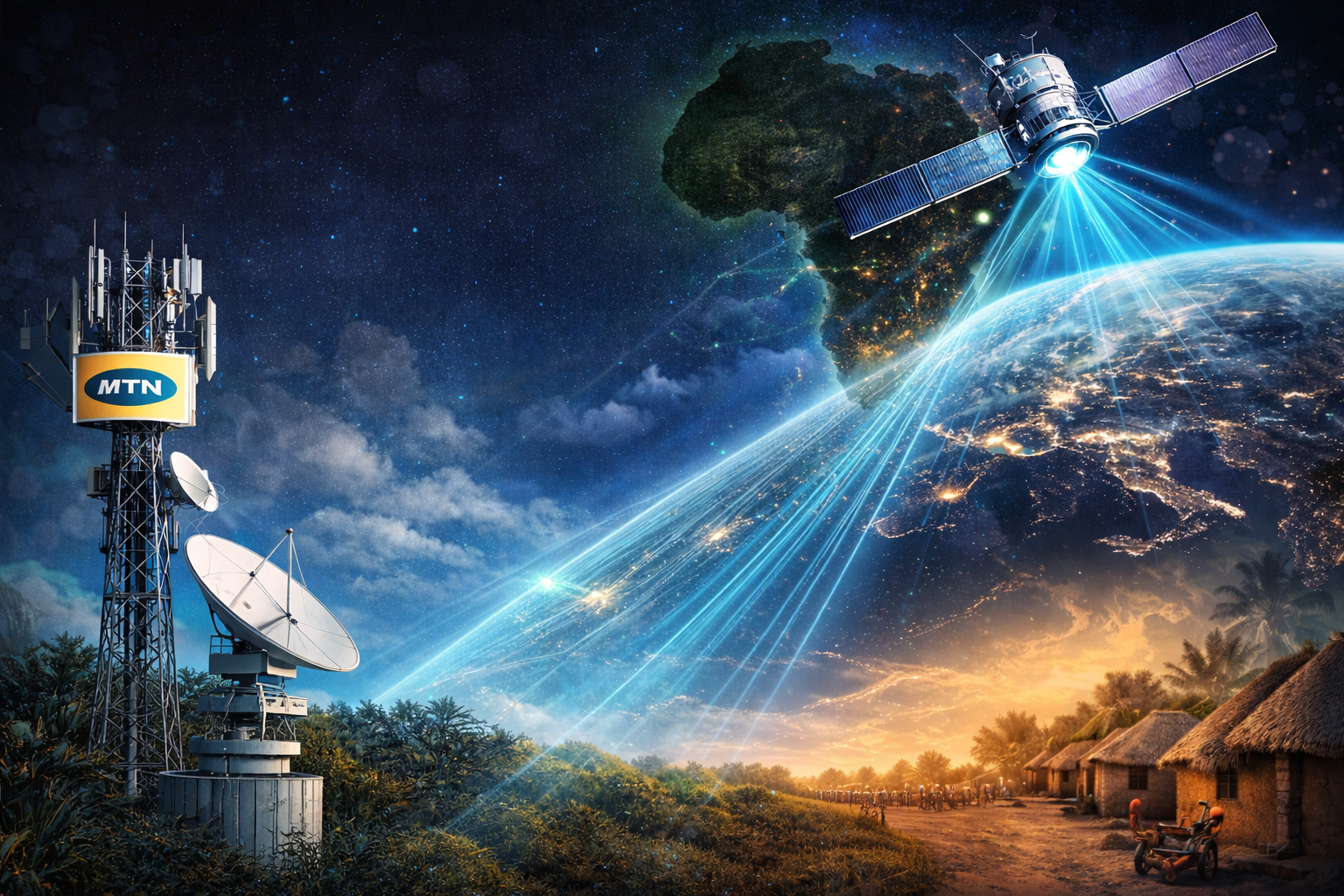
MTN Zambia is taking the initiative to provide satellite internet coverage for a country which has one of the lowest internet penetration in Africa.
To achieve this, MTN is leveraging the innovation of the most prominent internet service provider, Starlink, by utilizing its Direct-to-Cell technology.
Very recently, MTN Zambia confirmed that it has completed what it says is Africa’s first field trial of satellite-to-phone connectivity, utilizing the aforementioned technology.
This is in light of the fact that its competitor, Airtel Africa, revealed in December 2025, that it had partnered with SpaceX to roll out Starlink’s direct-to-cell satellite technology across all 14 of its African markets.
Beating Airtel to the punch, MTN Zambia disclosed its trial’s successful transmission of a mobile money transaction and a data session via satellites rather than a conventional ground tower, TechPoint reports.
Using Starlink’s satellite constellation and MTN’s spectrum, the test made it possible for a regular LTE smartphone to connect directly to satellites in space.
This was the first time a financial transaction was completed through the system in Africa, according to the business.
This implies that mobile connectivity may soon be able to reach locations where telecom towers are unable to reach.
Starlink’s direct-to-cell satellites, which link directly to phones and route signals across its global satellite network before connecting to the infrastructure of telecom carriers, function essentially as cell towers in space.
Direct-to-cell satellite connectivity
Direct-to-cell satellites eliminate the requirement for conventional ground cell towers by enabling regular mobile phones to link directly to satellites in orbit.
In low Earth orbit (LEO), a satellite carries radio equipment that functions similarly to a cellular base station, acting as a cell tower.
Similar to how it would connect to a local tower, your phone transmits a signal utilizing conventional 4G or 5G cellular frequencies.
Large antennae and sophisticated signal processing are used by the satellite to pick up the faint signal from a typical phone.
The call, SMS, or data is subsequently routed to the internet or another phone by a ground station or partner telecom network.
This technology offers coverage over oceans, deserts, mountains, and rural areas, permits emergency messaging and calls, and allows connectivity in remote locations without cell towers.
