


Concerns about the export of substandard goods to African markets have intensified this year, with more voices calling attention to the issue.
Recently, Kenyan High Court Advocate Gilbert C. Njoroge added new urgency to the debate, revealing that European companies have been exporting pesticides deemed unsafe in their own markets.
According to Njoroge, these products, considered too dangerous for use in Europe, are still being shipped to Africa with little regard for the health risks they pose.
Speaking to Sputnik during the International No Pesticide Use Day, he condemned Western firms for what he described as unethical and discriminatory business practices.
See here: Africa’s Growing AI-Powered Agriculture Movement
“Some of those chemicals are known carcinogens. […] They’re extremely poisonous, they’ve been banned in their countries of origin, yet the same companies are permitted by the Western jurisdictions in which they reside to export these harmful pesticides and herbicides into Africa.
He added that the decisions of these Western organizations, combined with the disproportionately high rates of severe illnesses among farmers exposed to these chemicals, prompted his legal team to pursue court action against several multinational corporations.
The lawsuit seeks to ban the use of highly hazardous pesticides and herbicides in the Kenyan market.
“And right now farmers are taking a preventative approach in terms of healthcare, so that we protect ourselves, we protect our farmers, we protect our nation, we protect our people from the huge health burden that is present at the moment,” he stated.
For Njoroge, the path forward is clear: prohibit dangerous pesticides, promote safer locally produced alternatives, and educate farmers on healthier agricultural practices.
A similar story in Nigeria
For years, farmers across northwest Nigeria have relied on low-cost insecticides and herbicides to preserve their corn, millet, vegetable, and other basic crops from locusts, weevils, and tenacious weeds.
These chemicals, the majority of which are imported and widely available in local markets, increase yields but are increasingly being connected to substantial health and environmental repercussions.
Rural clinics are reporting an increasing number of cases, including respiratory troubles, skin ailments, and other problems that doctors attribute to long-term exposure to cheap, unregulated agrochemicals.
Such is the case for Abdullahi Yusuf’s family, who have been growing corn, millet, and vegetables on an arid strip of land in northwest Nigeria’s dusty hills.
He feeds his family with the fruit and sells what he can at local markets, earning slightly more than $200 per month, as seen on Bloomberg.
Yusuf, like many farmers in Nigeria, relies on low-cost chemicals, the majority of which are imported, to protect his crops from pests, illness, and weeds.
Local experts told him that his daughter’s condition was most likely caused by pesticides and herbicides, citing a pattern of similar symptoms throughout rural Nigeria.
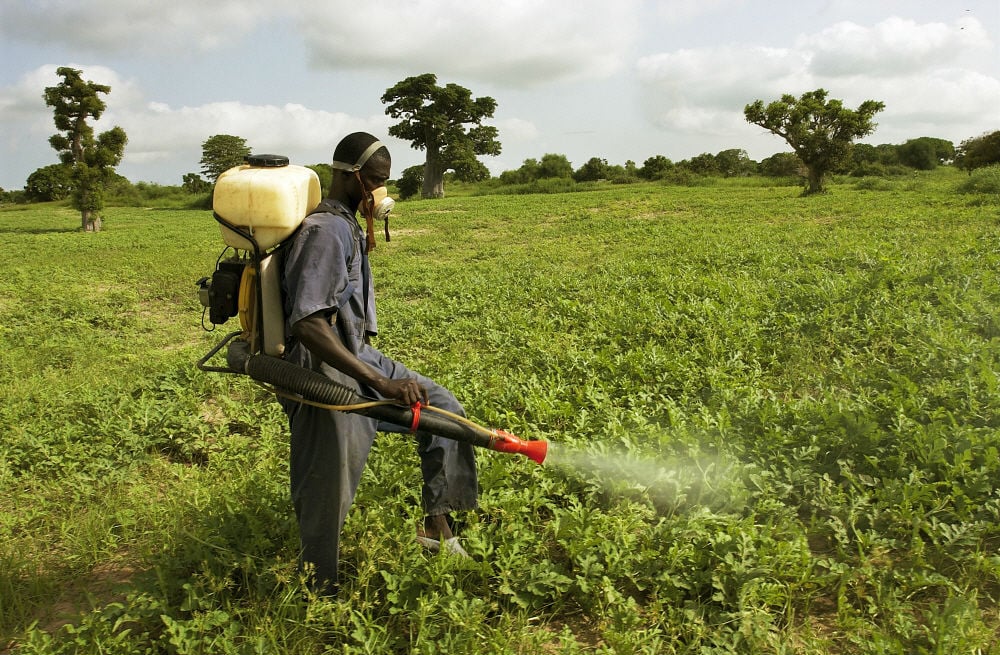
Yusuf had contemplated going organic, but “for small farmers like us, it feels too expensive and complicated.” Now, each time he straps on his backpack sprayer, he says, “It feels like I’m holding a knife to my throat.”
Although some farmers have thought about transitioning to organic methods, limited access to alternatives, increased costs, and a lack of government backing continue to impede the move.
