


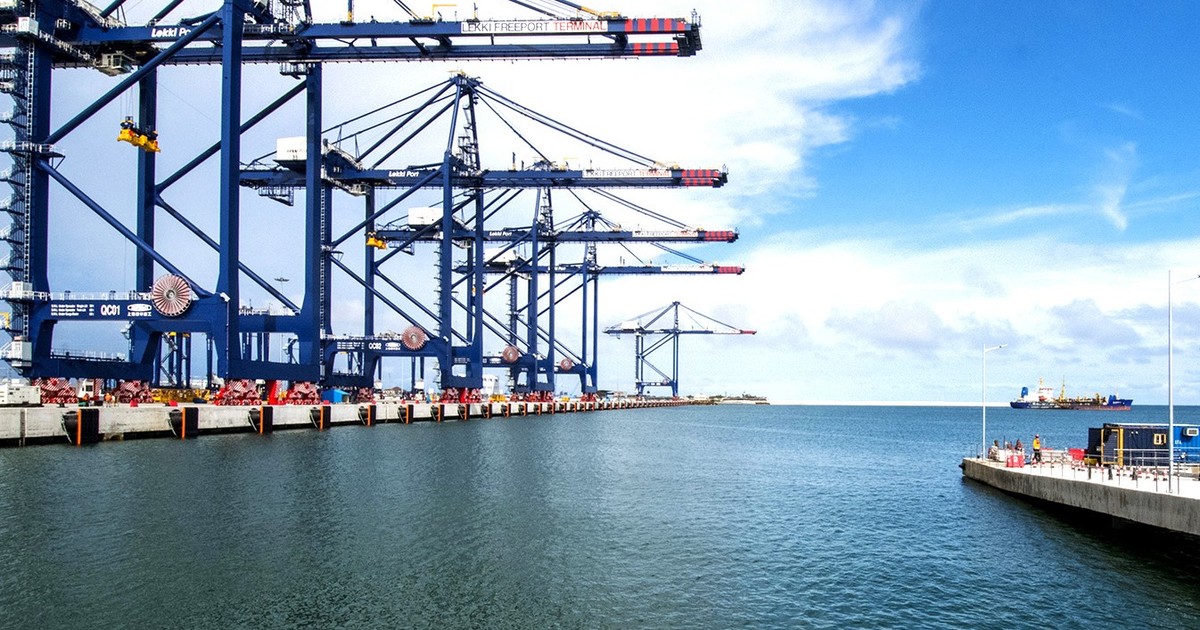
The export of fuel from the $20 billion Dangote Oil Refinery is one of the primary drivers of increased maritime activities in Nigeria.
Compared to the same half-year fiscal period last year, maritime exports in Nigeria for the first half of 2025 increased by 12%.
Recent reports indicated that maritime exports in Nigeria went from N38.27 trillion in H1 of 2024 to N42.87 trillion in the first half of the current year.
Outside of increased exports from the Dangote Refinery, the growth in figures was also driven by foreign exchange reforms and the country’s currency depreciation.
Data from the National Bureau of Statistics show that marine trade continued to outpace all other transport modes, including pipelines, roads, and airplanes.
Exports totaled N22.51 trillion in the second quarter of the year, compared to N20.36 trillion in the first quarter.
By contrast, N19.02 trillion was recorded in the first quarter of 2024 and N19.25 trillion in the second.
As reported by the Punch Newspaper, Dr. Muda Yusuf, the director of the Center for the Promotion of Private Enterprise, credited the expansion to the benefits of enhanced trade incentives and foreign exchange.
“The 12 per cent growth in maritime exports in the half-year is a reflection of the fact that the level of export has been increasing largely as a result of reform,” Yusuf stated.
“Exchange rate depreciation is a major driver of growth in exports because it makes your exports cheaper, more attractive, and you make more money,” he added.
The director also revealed that polices from the central bank under its new administration, including the unification of the exchange rate and liberalization of the forex market, are key reasons for the growth in exports.
“Under the previous CBN regime, Nigeria had two exchange rates: the official rate, which was N450, and the parallel market, which was about seven hundred and something naira.
See also: There is a new sheriff in town at the $20 billion Dangote Refinery
If you were an exporter who brought in foreign exchange officially, you had to sell it at N450. This meant losing money, and as a result, many exporters were discouraged,” Dr. Yusuf claimed.
“But with the current reform and the unification of the exchange rate, that differential has been removed. Whatever you now bring, you can get full value for it using the prevailing market rate,” he added.
Speaking on Dangote’s contribution to the growth, Dr. Yusuf stated, “The refinery is now exporting fertiliser, which is almost number two in non-oil exports, and refined petroleum products. That’s a very valid factor behind the growth.”
