


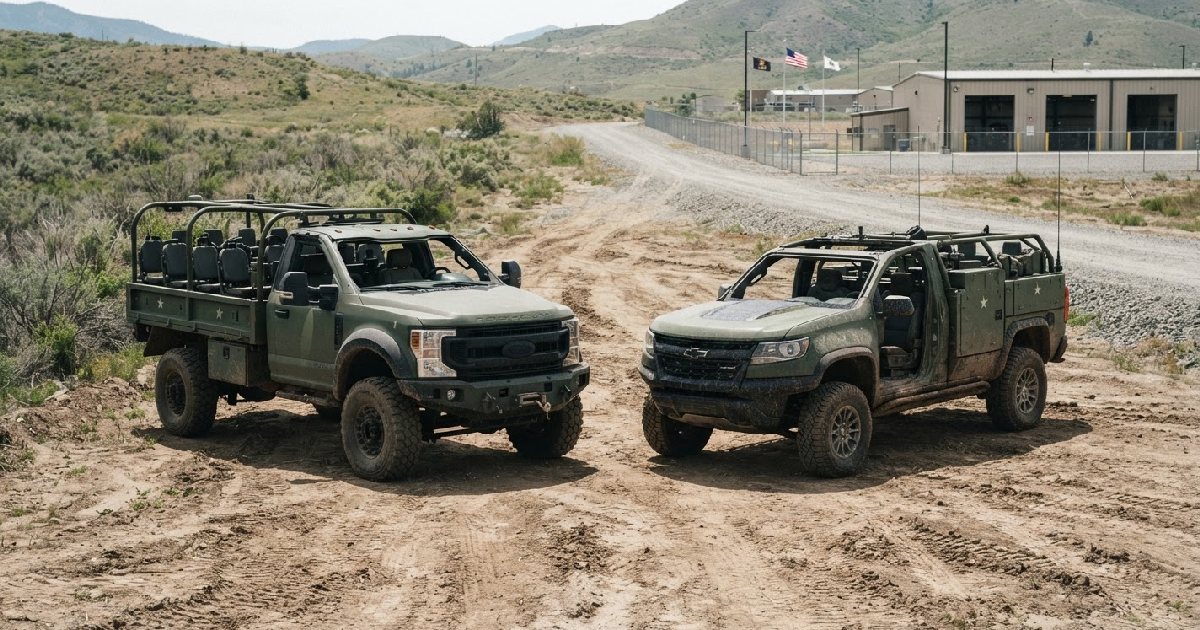
Ford, GM Defense, and BC Customs are developing ISV-Heavy prototypes for the U.S. Army’s Infantry Squad Vehicle-Heavy program. S. Army has commissioned Ford, GM Defense, and BC Customs to develop ISV-Heavy prototypes for its Infantry Squad Vehicle-Heavy program.
Each of the three automotive companies will now develop three ISV-Heavy prototypes, resulting in a total of nine vehicles. These will undergo rigorous testing and evaluation by the Army Test and Evaluation Command, with the first deliveries scheduled for March 30, 2027. The winning design will secure a contract to produce over 600 ISV-H vehicles.
Upgrading Military Mobility and Power Generation
The ISV-Heavy program addresses a critical capability gap, according to the U.S. Army. The new vehicles will function as robust troop transports and mobile charging units, giving soldiers the ability to generate exportable power for command posts in the field. This hybrid-powered design is a clear step towards enhancing operational flexibility on the modern battlefield.
The Pentagon’s broader strategy is to leverage the vast production capabilities and secure domestic supply chains of commercial automakers. This is a direct response to recent calls from President Donald Trump for automakers to participate more actively in munitions production. The push follows heightened military expenditures stemming from conflicts in Ukraine and with Iran.
Defining the ISV-Heavy’s Technical Demands
The Army’s specifications for the ISV-Heavy are stringent, reflecting the harsh conditions of military operations. These vehicles must accommodate six soldiers and carry a substantial 4,000-pound payload. They also need to tow a 6,500-pound trailer across challenging terrain.
Power generation is central to the ISV-Heavy’s mission. Each prototype must provide 60 kW of continuous high-voltage DC power, 15 kW of 28V DC power, and 4.8 kW of 120V AC power. The vehicles must operate effectively in extreme temperatures, ranging from -25 degrees Fahrenheit to 130 degrees Fahrenheit.
Further requirements dictate that the ISV-Heavy must travel 62 miles in eight hours on just three-fourths of a fuel tank. It also needs to replenish its power to 90% capacity within six hours. These metrics underscore the Army’s focus on endurance, self-sufficiency, and rapid operational readiness in diverse environments.
Right-to-Repair and Data Provisions
An important detail in the contract requirements is the inclusion of “right-to-repair” and data provisions. This indicates a focus on ensuring the Army can maintain and service these complex vehicles independently. It also suggests a level of transparency regarding vehicle data, crucial for military applications and future upgrades.
Automakers Accelerate Defence Sector Engagements
Both Ford and General Motors are increasingly looking to the defence sector as a significant growth area. These ISV-Heavy prototype contracts highlight a strategic pivot for major automotive manufacturers. They are actively seeking opportunities beyond traditional commercial vehicle markets.
Ford Motor Co., through its subsidiary Industrial Platform, will base its ISV-Heavy prototype on its F-Series Super Duty heavy-duty pickup trucks. President and CEO James Farley confirmed this during an earnings call, though he offered no further specifics on the Army contract. He did note Ford’s continued discussions with the U.S. government on other defence-related projects.
Farley sees defence as a promising “adjacency” for Ford, provided it offers “strong business with really good returns and really good capital returns.” This cautious but optimistic stance suggests a calculated expansion into government contracts. It capitalises on existing manufacturing expertise and large-scale production capabilities.
GM Defense’s Broadening Portfolio
GM Defense, General Motors’ dedicated defence arm, has been particularly aggressive in its pursuit of military contracts. This new ISV-Heavy contract builds on an existing agreement from June with weapons maker Lockheed Martin, aimed at bolstering domestic manufacturing for the defence industrial base.
Lockheed President and CEO James Taiclet stated their joint objective is to apply the automotive industry’s high-rate manufacturing and supply chain expertise to defence production.
Taiclet hopes this collaboration will provide greater access to the speed and scale of America’s commercial industrial base. This access is vital for accelerating output as demand for military hardware grows. GM Chairwoman and CEO Mary Barra echoed this sentiment, confirming GM Defense is working with other companies to “expand speed, scale and resilience” in the defence industrial base.
Barra also stated that GM’s efforts focus on strengthening supply chain management, improving manufacturing readiness, and expanding production capacity. These strategic initiatives are designed to serve the United States and its allies. She anticipates GM Defense becoming a more significant and diversified contributor to the company’s overall earnings.
GM Defense is indeed building momentum across various government entities. Its customers include the U.S. State Department, Secret Service, and agencies in Canada, Qatar, and Brazil. In May, GM secured a $220 million contract to build the Lunar Terrain Vehicle for NASA, showcasing its versatility across different high-tech applications.
The defence subsidiary is projected to reach nearly $700 million in revenue in 2026. Barra further estimates GM Defense’s compound annual growth rate (CAGR) revenue will exceed 30% over the next few years, with double-digit margins. The ISV-H awards alone are expected to surpass $1 billion, based on the Army’s requirements for over 600 vehicles.
Amid this expansion, General Motors and plane manufacturer Boeing are selling their research and development joint venture, HRL Laboratories, to IBM. Established as Hughes Research Laboratories in 1948 by Howard Hughes, this divestment suggests a focused strategy to streamline operations and concentrate on core growth areas within GM Defense.
BC Customs’ Specialised Contribution
The third awardee, BC Customs, a Utah-based specialized off-road outfitter, secured a $3.3 million Other Transaction Agreement (OTA). While smaller than the contracts awarded to the automotive giants, this award recognises their niche expertise in rugged vehicle design and customisation. BC Customs is working in cooperation with Raglan, a partner handling the electronic infrastructure for their prototypes.
This inclusion of a smaller, specialised firm alongside industry behemoths underscores the Army’s desire for diverse solutions and potentially innovative approaches. It allows the military to tap into agility and specific expertise that might complement the mass-production capabilities of larger manufacturers.
The Broader Industrial Impact of Defence Contracts
These prototype contracts represent more than just individual vehicle development; they signify a deepening integration between the commercial automotive sector and the defence industrial base. The push to modernise military fleets and replenish war materiel is creating substantial new revenue streams for manufacturers. This also incentivises them to dedicate production capacity to national security objectives.
The Army’s fiscal 2027 budget request outlines plans to purchase an initial 34 ISV-H vehicles at an estimated cost of $463,000 per truck. While this initial figure is high for a new platform, the Department of Defense anticipates acquiring at least 600 vehicles at a more economical cost of approximately $330,000 each.
This projected volume suggests a long-term commitment to the ISV-Heavy, offering significant production opportunities for the chosen vendor.
Such large-scale military orders provide stability and long-term planning horizons for manufacturing operations. They can also spur innovation within the automotive sector, as military requirements often push the boundaries of conventional vehicle technology, particularly in areas like hybrid power, advanced materials, and ruggedisation.
What Comes Next for the ISV-Heavy Programme
With prototype deliveries due by March 30, 2027, the coming months will be critical for Ford, GM Defense, and BC Customs. The Army Test and Evaluation Command will put these nine vehicles through their paces. This testing phase will be exhaustive, covering every aspect of the ISV-Heavy’s performance against the demanding specifications.
The competition is fierce, and the stakes are high, with a contract for over 600 vehicles on the line. The chosen design will not only provide the U.S. Army with an enhanced battlefield vehicle but also represent a significant industrial achievement for the winning manufacturer. It will shape future military ground mobility for years to come.
