


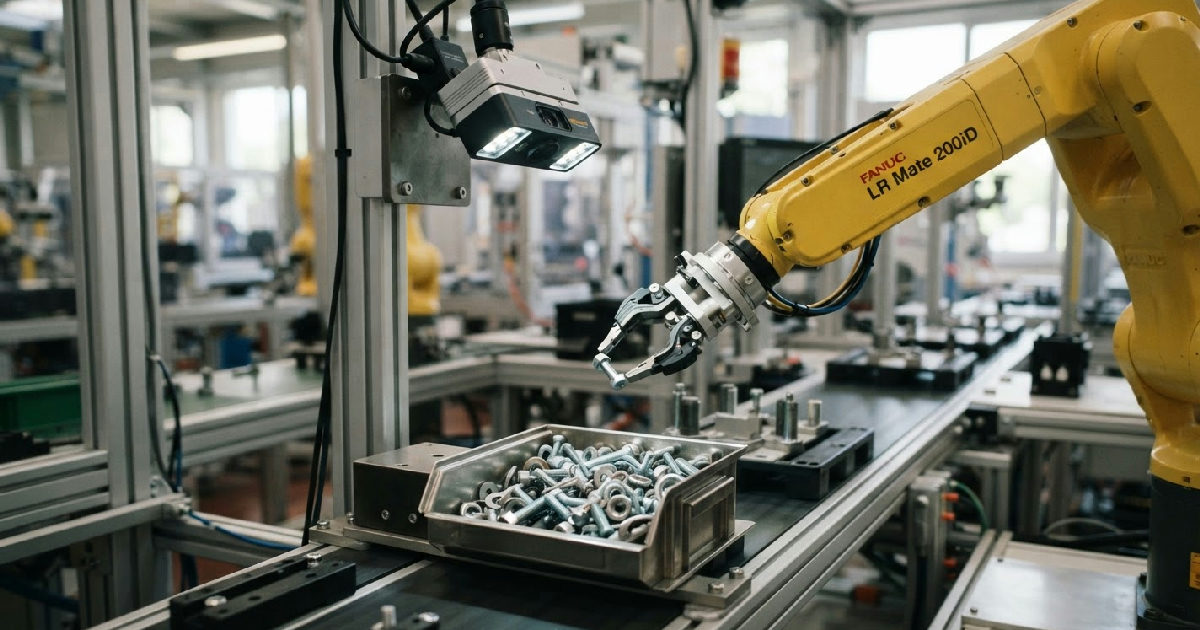
Picking individual bolts from a randomly arranged pile remains a challenge in industrial automation. AI-based machine vision, combined with 3D sensing and robotic motion planning, is helping manufacturers improve the identification and handling of small, reflective fasteners. Companies such as FANUC and Inbolt offer technologies for vision-guided robotic applications, although performance depends on the specific system, component and operating conditions.
How AI Machine Vision Enables Robotic Bolt Picking
This progress represents a significant stride towards more adaptive and intelligent manufacturing facilities. Industrial robots have traditionally performed best in applications where parts arrive in predictable positions and orientations. Picking bolts from a disordered pile is more difficult because the system must distinguish individual fasteners, estimate their positions and orientations, avoid collisions and select a feasible grasp. Conventional vision can handle some of these tasks, but reflective surfaces, overlapping parts and changing lighting can make reliable detection more challenging.
The fundamental difficulty stems from the limitations inherent in conventional machine vision. These systems typically struggle with the subtle surface textures and the often shiny, reflective qualities of metallic components such as bolts. They perform optimally when objects exhibit consistent shapes against uniform backgrounds, with predictable positioning. Consequently, a jumbled collection of identical or visually similar bolts presents a formidable task for such conventional approaches.
Moreover, the complexities introduced by fluctuating factory lighting and the wide array of fastener types in high-mix assembly operations demand a more robust technological solution. A vision system trained or configured for one bolt type may require additional calibration, training or model updates to recognise different fasteners. AI-based object detection can improve adaptability, although its performance depends on the training data, the variation in parts and the conditions in which the system operates.
A 2026 research paper by authors affiliated with Dongfeng Motor Corporation’s Research and Development Institute and Huazhong University of Science and Technology describes a vision-guided bolt-handling system combining AI-based detection, 3D pose estimation, grasp planning and collision-aware trajectory planning. In controlled experiments, the system achieved an overall grasping success rate of 97% across 1,000 trials.
These advancements are a core component of building truly automated factories of the future.
How AI and 3D vision solve the problem
YOLO, short for “You Only Look Once”, is a family of object-detection models designed to identify objects and estimate their locations in an image in a single forward pass. This approach can support real-time applications where robots must locate parts quickly.
This unified pipeline processes entire images through a single convolutional neural network (CNN) just once, rapidly identifying all objects and their precise locations.
The research paper from Dongfeng Motor Corp. Research and Development Institute and Huazhong University of Science and Technology employed an optimised version called YOLOv8n-BoltLite. The researchers developed YOLOv8n-BoltLite, a modified YOLOv8n model incorporating feature-extraction, attention and detection enhancements designed to improve recognition of small, slender bolts.
The model achieved a five-run average mAP of 99.64% on the controlled test set, with an inference speed of 198 frames per second. On a more challenging external test set involving reflections, clutter, partial occlusion and lighting variation, its mAP was 94.62%.
In a typical vision-guided picking system, 2D object detection can be combined with depth information from a 3D camera to estimate a part’s position and orientation. FANUC’s 3DV/400, 3DV/600 and 3DV/1600 are examples of industrial 3D vision sensors that can supply depth data for suitable applications. Depth data can help the system estimate a bolt’s six-degree-of-freedom (6DoF) pose: its position along the X, Y and Z axes and its orientation around those axes. The estimate is subject to sensor resolution, calibration accuracy, occlusion and the geometry of the part.
Armed with this comprehensive data, the robot can determine not only the bolt’s position but also its precise orientation, facilitating an accurate grasp. In the research system, the grasp planner uses the bolt’s geometry to select a suitable grasp point, including a mid-shank position where appropriate. The choice of grasp point can influence stability during movement, but the best strategy depends on the bolt’s shape, orientation, gripper design and planned trajectory.
Advanced techniques for real-time robotic perception
Inbolt offers CAD-based robot programming and 3D perception technology designed to identify parts from their digital models, reducing the need to collect and label large image datasets for each new component. The company advertises setup or training times of less than five minutes for its relevant tools, although actual deployment time depends on the application and integration requirements. It’s a significant advantage for high-mix, low-volume production scenarios, where product variations are frequent.
FANUC’s AI bin-picking solutions have used NVIDIA GPU hardware to support deep-learning applications. Separately, FANUC’s R-50iA controller supports direct Python execution, allowing developers to integrate selected data-processing and AI workflows into robot-control systems. These capabilities are model- and configuration-dependent and should not be taken to mean that every FANUC robot includes an NVIDIA GPU or supports Python natively.
From lab to factory floor implementation
The practical impact of this technology is clearly demonstrated in its real-world industrial deployments. At Stellantis’ Trenton engine plant in Michigan, Inbolt deployed real-time vision guidance to help a robot locate bolt positions during engine assembly, compensating for variations in engine position without requiring changes to the existing production-line infrastructure.
According to Inbolt’s case study, the system reduced the tool’s non-engagement rate from 2.55% to 0.24% and lowered overall part rejections by 90.5%. These results were reported for the specific Stellantis application and should not be assumed to represent typical performance across other factories.
Mech-Mind reports a bolt-recognition success rate of at least 99% and positioning accuracy of ±1 mm for one of its 3D vision-guided bolt-tightening applications. The company states that the system is designed for continuous production use. These are not experimental setups; they are industrial workhorses driving productivity.
FANUC introduced its AI Bin Picking FIELD application in 2018 in collaboration with Preferred Networks. The deep-learning-based application helps determine the order in which objects should be picked, reducing the need for extensive manual parameter tuning.
Integration is also becoming more streamlined across the industry. System integrators such as Southwestern PTS offer automated screwdriving systems that combine FANUC CRX collaborative robots with ESTIC fastening tools. The integration brings together robotic positioning and controlled fastening, although the exact configuration depends on the application.
For example, the FANUC CRX-10iA/L offers a 10 kg payload and a reach of 1,418 mm. When integrated with suitable vision systems and ESTIC fastening tools, it can support applications requiring precise robot positioning and controlled screwdriving. This modular, best-in-class approach accelerates the adoption of advanced robots for logistics and assembly operations across various industrial sectors.
The collaborative ecosystem of flexible automation
Advances in robotic bolt handling depend on the integration of several technologies, including robot hardware, machine vision, perception software, motion planning and application engineering. FANUC provides the robust and dependable robotic platforms, including their newer, easy-to-program collaborative robots. These platforms are engineered for reliability and precision in demanding industrial settings.
Specialised vision companies, such as Inbolt and Mech-Mind, furnish the “eyes” and the “brain” for these systems. They develop sophisticated perception software that translates raw visual data into actionable intelligence for robots.
Inbolt advertises real-time 6DoF part localisation and reports perception-to-motion processing in under 80 milliseconds, with localisation accuracy of approximately 0.5 mm for its relevant platform. These are vendor-stated specifications and should be tied to the specific camera configuration and operating conditions.
Inbolt’s vision-guidance platform is designed to support bin picking and robot guidance in changing production conditions. Actual picking performance depends on the part geometry, pile arrangement, gripper and application configuration. FANUC supports high-speed robot-control and motion-communication capabilities, including a 1 ms communication cycle for its Stream Motion technology. This is a control-system specification, not evidence that every FANUC robot performs 3D visual tracking at 1 ms.
GPU hardware from companies such as NVIDIA can accelerate deep-learning inference and other computationally intensive tasks in industrial vision systems. The hardware required depends on the model, performance target and system architecture; not every bolt-picking application requires a dedicated high-performance GPU.
The combination of robotics, AI-based perception, 3D sensing and motion planning is making bolt handling more adaptable to variations in part position and orientation. For manufacturers, the potential benefits include reduced reliance on rigid fixtures, more flexible production and improved consistency, provided the integrated system is validated under real operating conditions.
