


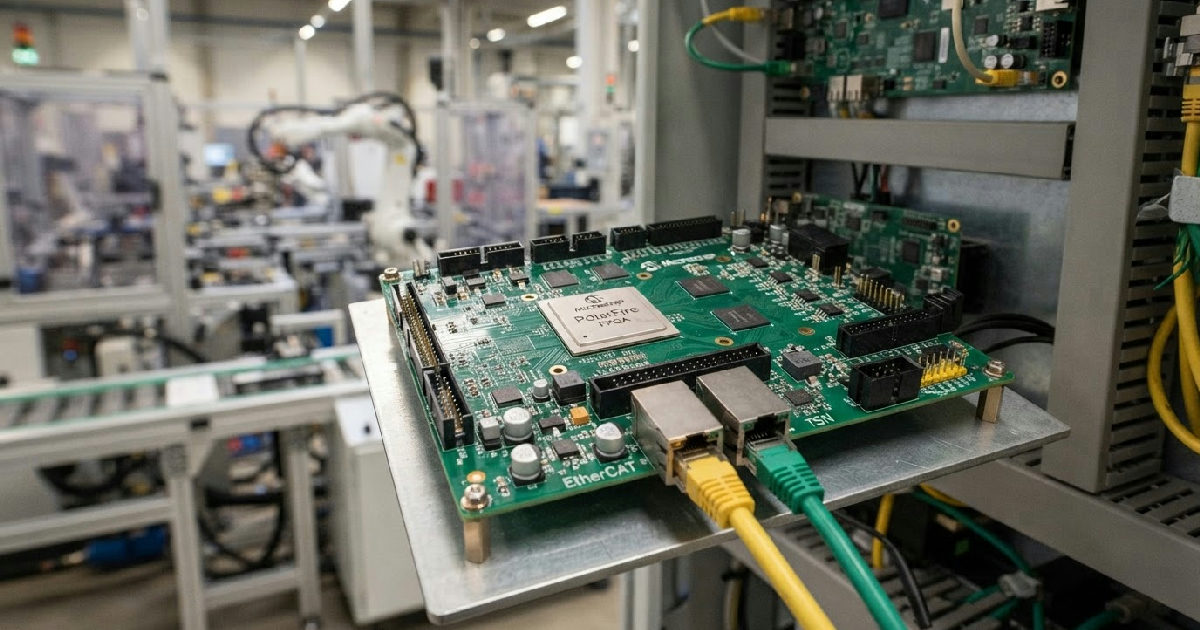
Microchip Technology has expanded its industrial edge networking portfolio by integrating two key technologies—EtherCAT and Time-Sensitive Networking (TSN)—into its PolarFire FPGAs and SoCs. Announced on 29 October 2026, the integration gives developers a unified, low-power platform for building deterministic, real-time networks for modern factories.
The integration addresses complex communication challenges associated with Industry 4.0. Shakeel Peera, vice president of Microchip’s FPGA business unit, said the addition of these capabilities to the power-efficient PolarFire platform would support deterministic networking for highly responsive, scalable systems. The integration is intended to help customers develop new industrial and embedded networking applications.
The deterministic networking challenge in automated factories
As factories deploy more AI-driven robots, smart sensors, and edge-computing systems, the need for predictable, low-latency data exchange has become increasingly important. Conventional Ethernet configurations, widely used in IT environments, may not meet the strict timing requirements of operational technology (OT) without additional mechanisms. Ethernet’s best-effort delivery model is effective for general data transfer but may be unsuitable for applications that require tightly controlled communication delays.
In applications such as multi-axis motion control and synchronised robotics, variable latency and jitter can cause control errors, equipment damage, or unsafe operating conditions. These disruptions can halt production lines or endanger personnel working alongside collaborative robots. A network must not only transmit data quickly but also provide predictable communication and meet defined timing requirements.
The convergence of IT and OT adds to this challenge. Modern manufacturing requires factory-floor data to be available for higher-level analysis without compromising real-time control.
Transmitting sensor data to cloud-based analytics while meeting the response-time requirements of critical control loops requires a network that can manage different types of traffic predictably.
Industrial systems must handle high-bandwidth machine-vision data alongside time-critical commands for servomotors. Microchip aims to simplify this challenge with its expanded PolarFire platform, supporting more integrated industrial operations.
Integrating EtherCAT and TSN for deterministic communication
Rather than relying on a single technology, Microchip is integrating EtherCAT and TSN, which offer different capabilities for deterministic networking. This allows engineers to select the technology best suited to each application within a shared hardware platform.
The integration combines EtherCAT IP from Beckhoff Automation GmbH with Microchip’s own TSN IP to support next-generation industrial equipment.
Beckhoff’s EtherCAT IP supports high-speed, synchronised machine control at data rates of up to 1,000 Mbps. EtherCAT processes Ethernet frames “on the fly”, allowing each slave device to read its assigned data and insert its own output data as the frame passes through.
This approach reduces communication overhead and supports time-critical control loops within machines, including those used in robotic factory-logistics systems.
Microchip’s TSN solution supports deterministic Ethernet communication at 1 Gbps using IEEE 802.1 TSN standards. TSN adds mechanisms to standard Ethernet that can provide bounded latency, reduced packet-delay variation, and prioritised handling of time-sensitive traffic. These capabilities make TSN suitable for plant-wide networks that need predictable communication between machines and control systems.
Key TSN features integrated into the PolarFire platform include time-aware scheduling (IEEE 802.1Qbv) and timing synchronisation (IEEE 802.1AS), which help network devices maintain a common time reference. FFrame pre-emption (IEEE 802.1Qbu) and per-stream filtering and policing (IEEE 802.1Qci) further improve traffic management and help protect time-sensitive traffic from interference by other data streams.
Securing and powering the industrial edge
The new capabilities are built on the power-efficient PolarFire FPGAs and SoCs, which are designed for real-time computation, reliability, and energy efficiency. PolarFire devices feature a secure, non-volatile architecture that enables instant-on operation. This is important for industrial applications where rapid start-up and resilience to power interruptions are required.
Integrated security features, such as secure boot and anti-tamper protection, help protect industrial systems against cyber threats. As more intelligence moves to the edge, protecting these distributed systems from unauthorised access and malicious manipulation becomes increasingly important. The flexible FPGA fabric allows for scalable customisation, adapting to evolving industrial network architectures and security demands.
These features extend the applicability of PolarFire devices to demanding industrial edge applications. These include autonomous mobile robots operating in dynamic environments, smart infrastructure requiring real-time data processing, and aerospace and defence platforms. The combination of deterministic networking, security, and low power consumption makes the devices suitable for distributed industrial applications, including advanced robotic systems such as cobot welding solutions.
Accelerating development in advanced industrial systems
Microchip supports engineers with a development ecosystem designed to simplify and accelerate the integration of these capabilities. This includes the Libero SoC design suite, a range of IP cores, and validated reference designs. These tools provide a foundation for engineers to implement industrial networking solutions more efficiently.
Hardware support includes the Dual-Port Gigabit Ethernet FMC card (ETH-DC-DUALGBE) and the PolarFire SoC Video Kit (MPFS250-VIDEO-KIT) for evaluation and prototyping. The PolarFire SoC FPGA Motor Control Kit combines FPGA-based real-time control, embedded processing, motor and sensor interfaces, TSN-enabled networking, and integrated debugging capabilities to support the development of motion-control systems.
This integrated development approach is intended to reduce time to market for industrial applications requiring high-performance, deterministic communication. It allows engineers to focus on application-specific development rather than re-engineering core networking infrastructure. Microchip’s continued investment in its FPGA solution stack is intended to support developers working on industrial networking, AI, machine learning, and security-focused applications.
