


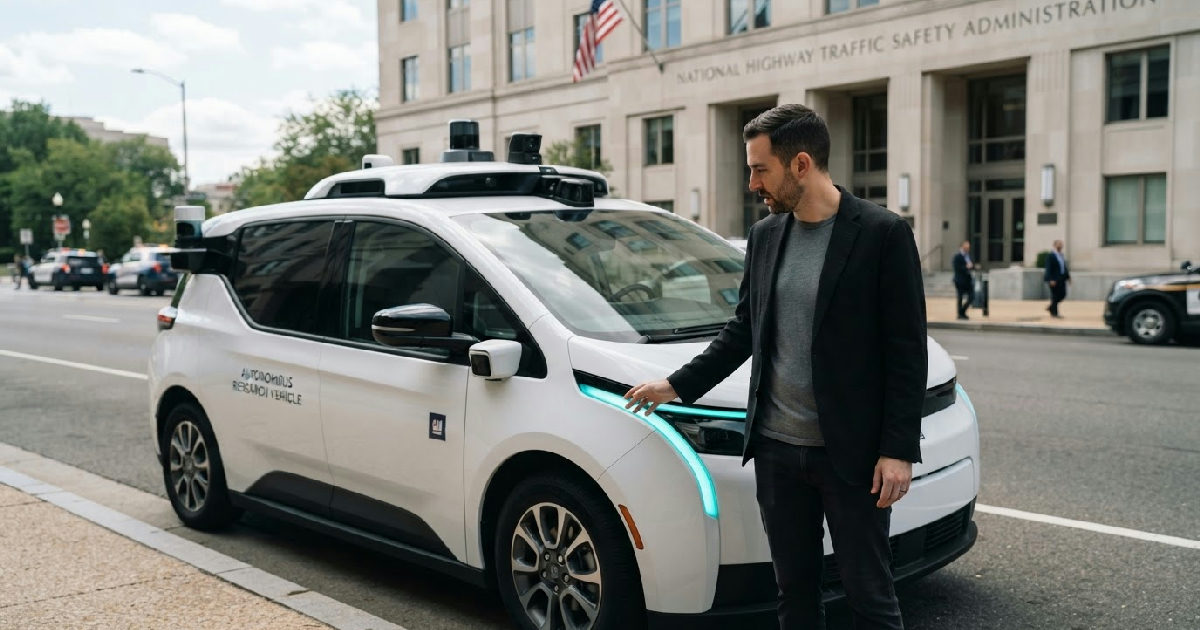
NHTSA suggests cyan for the proposed standard identifying autonomous vehicle identification lights, aiming for enhanced safety and clarity. S. National Highway Traffic Safety Administration has proposed a new standard for autonomous vehicle identification lights, and NHTSA suggests cyan as the color of choice. This move aims to enhance safety and clarity for other road users regarding the operational status of self-driving cars.
Jonathan Morrison, NHTSA Administrator, stated that the proposal aims to streamline regulatory updates. It seeks to accelerate the adoption of autonomous vehicles (AVs) while maintaining stringent safety protocols. The initiative underscores a broader push to align regulatory frameworks with rapidly evolving automotive AI capabilities.
Why NHTSA suggests cyan for AVs
NHTSA’s proposal outlines specific equipment specifications for these indicator lights, covering their mounting, colour emission, and activation mechanisms. Crucially, these cyan lights would remain steadily illuminated, rather than flashing, and need to be visible from all sides of the vehicle.
While the agency isn’t mandating the blue-green colour, it serves as a strong recommendation for industry adoption. This standardisation is critical for both the public and law enforcement to immediately recognise when a vehicle is operating in autonomous mode, particularly without a human driver ready to intervene.
The push for uniform autonomous vehicle lighting reflects an international consensus forming around the Society of Automotive Engineers (SAE) J3134 standard. This global benchmark is currently the only lighting standard developed specifically for automated vehicles, recommending blue-green as an international identifier for an active Automated Driving System (ADS).
The Rationale Behind Cyan
The choice of cyan is deliberate. It’s distinct from blue lights used by emergency services, preventing confusion and ensuring clear communication on the road. Mercedes-Benz has already begun integrating blue-green ADS marker lamps that conform to the J3134 standard on its Level 3 vehicles, showcasing early industry alignment.
China, a major player in automotive innovation, also plans to adopt a similar indicator. A draft standard released in October 2026 proposes turquoise as its designated colour for AV indicators, taking effect in 2028. This global convergence around a specific colour aims to bring clarity to an increasingly complex traffic landscape.
Broader Regulatory Landscape for Autonomous Driving
NHTSA’s lighting proposal is one component of a much larger federal strategy to update existing motor vehicle safety standards. Current Federal Motor Vehicle Safety Standards (FMVSS) were not designed for the unique configurations of purpose-built AVs, such as the Tesla Cybercab or Zoox robotaxi, which lack traditional controls like steering wheels and pedals.
Jonathan Morrison, confirmed as NHTSA Administrator in September 2025, leads the agency’s efforts to establish a comprehensive federal automated vehicle framework. His experience from Apple’s Special Projects Group informs this approach, balancing innovation with the paramount need for safety. The agency is now scrutinising novel vehicle designs to ensure compliance without stifling technological progress.
Evolving Vehicle Safety Standards
The modernisation of FMVSS 108, which governs automotive lighting, has been ongoing, with amendments as recent as February 2022. This continuous revision reflects the rapid technological shifts within the automotive sector. NHTSA also announced its intent to form a Negotiated Rulemaking Advisory Committee for Vehicle Lighting, potentially taking up to two years to develop further recommendations.
Regulatory scrutiny extends to new vehicle designs. Tesla’s Cybercab, for example, is under an NHTSA audit, which began in September 2026. This audit evaluates Tesla’s basis for self-certifying the Cybercab’s compliance, contrasting with Amazon-owned Zoox, which secured exemptions for its robotaxi, allowing commercial deployment in locations like Las Vegas.
International Precedents for AV Signals
Beyond the U.S., other nations are also establishing clearer guidelines. The UNECE and China are considering additional requirements for rear and side marker lamps to achieve 360-degree visibility for AVs. This coordinated global effort highlights the universal challenge of integrating autonomous technologies safely onto public roads.
The importance of robust testing and certification workflows cannot be overstated as these technologies mature. The industry relies on modernised physical test workflows to validate the safety and reliability of complex autonomous systems before widespread deployment.
Automotive Giants Accelerate AI and Autonomy Plans
Major automotive manufacturers are embedding artificial intelligence deeply into their development processes and future vehicle architectures. General Motors (GM), for instance, unveiled a comprehensive overhaul of its electrical and computational systems at its annual GM Forward event.
This initiative aims to deliver faster software updates and more advanced automated driving features. The integration of enterprise AI is projected to halve GM’s traditional four-to-five-year vehicle development timeline, signaling a significant acceleration in industrial output and product innovation.
GM’s Computational Overhaul
GM’s technological shift will debut in 2028 with the Cadillac Escalade IQ. This vehicle will feature an autonomous highway driving system enabling hands- and eyes-off operation, eliminating the need for immediate driver take-over. The Escalade IQ will also use turquoise lighting on its dashboard and exterior mirrors to indicate when this eyes-off feature is active.
Underpinning this advancement is a new liquid-cooled central compute unit (CCU), engineered to provide approximately 40 times the computing power of current GM vehicles. This CCU will centralise controls for autonomous driving, active safety, propulsion, and chassis, creating a more integrated and capable system. Furthermore, GM is revamping its OnStar service with a custom, conversational AI assistant, transforming its 30-year-old telematics platform.
Rivian’s Simulation Push
Rivian, another prominent player in the electric vehicle market, recently acquired Third Dimension, a U.K. startup specialising in AI-driven 3D world creation from images and videos. This acquisition directly supports Rivian’s ambition to accelerate its self-driving capabilities by closing the “sim-to-real gap”—the disparity between simulated and real-world driving data.
James Philbin, Rivian’s head of autonomy, emphasised the necessity of this technology to create virtual environments that accurately mirror physical reality. While simulation has been a staple in AV development, companies like Third Dimension are advancing its sophistication, making startups in this domain attractive acquisition targets for larger manufacturers.
Rivian CEO RJ Scaringe envisions a future where autonomy allows for radically different vehicle designs, moving beyond current electric trucks and SUVs. The company is also developing its own AI models for in-vehicle assistants and an end-to-end automated driving stack, along with custom 5nm processors in collaboration with Arm and TSMC.
Rivian’s industrial strategy includes a $5.8 billion joint technology venture with VW Group, with aims to expand this to cover AI and autonomy and license its technology.
Investment Fuels Next-Gen Mobility
The broader autonomous mobility sector continues to attract substantial investment, underscoring confidence in its long-term potential. Startups are securing significant funding rounds, and partnerships are forming to accelerate the deployment of various autonomous solutions.
Reliable Robotics, focused on autonomous flying technology for existing aircraft, recently completed a $115 million Series D extension round. This included $90 million in equity funding led by Nimble Partners and $25 million in debt from Silicon Valley Bank, pushing the startup’s valuation beyond $1 billion. Such investments demonstrate a belief in automating even more complex transportation systems.
Robotaxis and Flying Autonomous Tech
The global race for robotaxi deployment is intensifying. Ride-hailing firm inDrive is partnering with Chinese autonomous driving company Pony.ai and Nvidia to launch robotaxi tests in Kazakhstan by 2027. This collaboration highlights the growing trend of cross-border alliances to bring self-driving services to new markets, extending beyond traditional automotive strongholds.
Waymo, a leader in robotaxi services, plans to expand its operations to Madrid, Spain, in 2027, alongside offering rides at Harry Reid International Airport in Las Vegas. These expansions signal a move towards greater accessibility and market penetration for fully autonomous ride-hailing.
Even established industrial players are embracing autonomous capabilities. Kodiak AI, a self-driving truck company, along with Aurora Innovation, received a federal exemption allowing them to replace roadside warning devices with cab-mounted beacons. This practical adjustment addresses the operational realities of autonomous heavy-duty transport, where major industrial upgrades are often required to integrate new technologies seamlessly.
The Road Ahead for Autonomous Systems
The confluence of regulatory clarification, substantial corporate investment, and rapid technological advancement points to a pivotal period for autonomous systems. The proposed cyan lighting for autonomous vehicles represents a small but significant detail in the complex tapestry of integrating these technologies into daily life.
From AI-accelerated development cycles at GM to Rivian’s sophisticated simulation efforts, the manufacturing and engineering sectors are transforming at an unprecedented pace. These developments are not just about new vehicles; they’re about redefining how products are made, tested, and ultimately deployed on a global scale, including in emerging markets where infrastructure is still developing.
As regulations evolve and technology matures, the focus remains on ensuring safety and public trust. The standardisation of visual cues like autonomous vehicle lighting will play a crucial role in building confidence, paving the way for broader acceptance and the full realisation of self-driving capabilities in transportation systems worldwide.
