


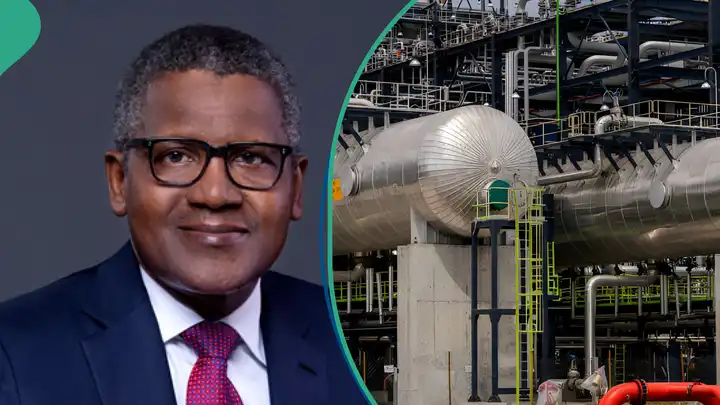
Dangote Petroleum Refinery and Petrochemicals (DPRPL) is entering a new phase in its development with the impending public offering of its shares in Nigeria’s capital market, one of the largest industrial projects in Africa being brought right to the capital market.
The IPO, which will run from 14th September 2026 to 13th October 2026, is estimated to generate approximately ₦2.15 trillion ($1.63 billion) from the offering of 4.1 billion ordinary shares at ₦525 per share. The refinery should be listed on the Nigerian Exchange later in the year.
The business deal is not Dangote’s latest fundraising bid. It is a change in the mode of financing, valuing and scaling one of the most ambitious engineering projects in Nigeria.
The refinery cost an estimated $20 billion to build and was in operation in 2024. It has since grown to be a significant player in Nigeria’s petroleum market and can process a wide variety of crude grades and has a current processing capacity of approximately 650,000 b/d.
With Dangote looking to attract public investors, the only question now is whether the size of the refinery is too small or too large. It’s more and more concerning whether the huge capital and engineering effort can sustain output, cash flow, profitability and long haul industrial worth.
From engineering project to investable industrial asset
The Dangote Refinery is a prime example of this tendency of engineering and finance merging in the development of large industrial projects.
The capital investment needs for this type of refinery were in the billions of dollars, process engineering was a complex endeavor, a large storage system was needed, marine facilities, pipelines, utilities and logistics systems. However, when the facility is in commercial operation, it is impossible to separate engineering performance from the financial performance.
Each gain in throughput, greater utilisation, lowering of operating costs or expansion to more profitable petroleum products will have an impact on the economics of the business.
That’s what makes the IPO so significant.
The public offering provides the investors with a chance to gain the economic values created from an industrial asset built beyond the construction phase and into full-scale production.
The deal is likely to be among the biggest public offerings in Nigeria’s capital-market history. The overall valuation of the refinery is reported to be about $47 billion and the offer is a significant infusion of new capital into the company.
The proposed valuation scale can also put a huge spotlight on the potential of the refinery to justify its industrial and commercial potential.
Why the IPO matters to the refinery’s next stage
According to Dangote, the proceeds from the listing will be used to finance the expansion of the refinery and other infrastructure projects.
The company is planning to boost refining capacity from its current level to some 1.4 million barrels per day, more than doubling the facility’s capacity. Aliko Dangote has now predicted that the expansion will eventually make the refinery the world’s largest by 2028.
That expansion must be seen as an integral part of the IPO and not a standalone project.
The reasoning is simple: more capacity means more capital; the IPO offers a way to attract more investors to the business and to establish a diversified ownership base.
The company has also spotted investments in infrastructure beyond the refinery – such as tank farms around the continent and future plans for additional refining facilities in East Africa. Dangote has announced its plans to build another refinery on the east coast of Kenya, backed by the governments in the region.
What is implied is that the Nigerian refinery is getting put under another umbrella, instead of being a stand-alone refinery, it is now being looked upon as a base for a much larger energy and industrial network.
The business of engineering at massive scale
The Dangote story becomes interesting in the manufacturing and engineering industry where this is the case.
For large industrial projects, the cost of construction, size, and technological complexity are typically the criteria used to start a discussion about construction. But at the end of the day, an engineering asset must be a business.
While a refinery can be technically impressive, its long-term success depends on its ability to process crude oil into commercially valuable products, on the energy and operating costs, and on its utilisation levels, as well as its ability to meet market conditions.
There is an additional layer of accountability with the IPO. Public investment in the business begins to increase the importance of performance indicators such as production volumes, margins, operating efficiency, capital expenditure and profitability.
The engineering choices made within the refinery can thus have direct consequences for investors.
For instance, increasing process efficiencies will help to lower costs. Increased equipment availability may lead to higher production. Downtime can be minimised by doing good maintenance. Expansion can lead to bigger revenue. And investments in supporting infrastructure can improve the movement of crude and refined products.
In this regard the business of engineering becomes the business of creating and protecting industrial value.
A refinery with implications beyond petroleum
The project’s economic impact goes beyond the refinery’s bottom line. The establishment has generated demand from a broad industrial ecosystem of engineering contractors, suppliers of equipment, logistics, maintenance and technical service providers, among others.
It is estimated that its expansion would make that ecosystem deeper. The larger the refinery the more infrastructure, maintenance, logistics capacity and special expertise will be needed. It can also provide businesses providing storage and moving services, as well as those in the downstream products from oil and gas sector such as petrochemicals.
This is especially true of Nigeria where historically development of large industrial assets has been limited by infrastructure shortages, lack of a robust industrial base and reliance on imported equipment and technical expertise.
Therefore if more of the value chain of such a project can be strengthened locally, it can have a multiplier effect.
But the question now is whether Nigeria can develop the industrial capabilities around the refinery fast enough to be able to claim a significant cut of that value.
Opening industrial ownership to public investors
The IPO also alters the relationship between the refinery and the general public of Nigeria.
Dangote has cited opportunities for Africa to own a big industrial asset as a reason for the listing many times. He has stated that the offering would be used to expand access to the refinery and give all people with varying income levels a chance to benefit from its development.
The minimum subscription is 10 shares worth of ₦525 per share = ₦5250.00.
Its significance is that it changes the focus of the refinery from one almost entirely based on the refinery’s founder and private ownership to one with a much wider foundation of investors.
It also helps to establish a new test for Nigeria’s capital market.
The offering is likely to be one of the biggest ever IPOs in the Nigerian Exchange. The listing could have a major impact on the total market capitalisation of the NGX if it draws significant fresh capital, earlier economist Bismarck Rewane had projected.
If successful, the transaction could demonstrate that Nigeria’s capital market is capable of absorbing and financing large-scale industrial enterprises rather than primarily serving as a market for established financial and consumer companies.
From national project to regional industrial platform
In addition, Dangote has stated its intentions to build more energy projects in Africa, such as a refinery in Kenya. The firm has also said it could also be part of a broader petroleum supply plan in the region. This is an interesting industrial offer.
It is no longer enough to consider Dangote Refinery as just a production plant that makes petrol, diesel, aviation fuel and other petroleum products, but rather a hub where a more comprehensive network of energy products infrastructure is developing.
It may involve storage facilities, logistics networks, distribution networks, petrochemicals and extra refining facilities.
In terms of the size of such an ecosystem, the refinery becomes more and more significant to the energy market in Nigeria and to the industrialisation of West and East Africa in general.
The challenge after the IPO
The success of the IPO will ultimately rest on investor demand. After listing, the same basic question that any big industrial company will have to answer will apply: Can the refinery deliver on its financial and operational results over time?
Production levels, refinery utilisation, operating costs, product margins, crude supply, exports and the rate of execution of expansion projects will all be under investor focus.
In addition, the projected ramp-up to 1.4 million bpd presents a hefty capital and execution challenge. Increasing capacity is an engineering problem. Making the capacity a part of an operational industrial system, while retaining reliability, safety and commercial efficiency, is a much bigger one.
The refinery is thus coming to the capital market at a crucial time. It has already proven that an extraordinary scale project can be constructed in Nigeria. The next challenge is to demonstrate that such assets can continue to create value on a scalable basis.
What Dangote Refinery’s IPO means for Nigerian industry
This is a significant event, not just for Dangote Industries or the Nigerian Exchange, but for the concept of industrial investment in Africa.
The continent has long grappled with a familiar problem: huge infrastructure and manufacturing investments are costly, and the financial markets are relatively shallow and don’t offer sufficient liquidity.
The Dangote Refinery IPO is a different model. It enables the African people to put a significant industrial project before the public investors, and allows the possibility of linking the money of the Africans with the industrial assets of the Africans.
The success of this offering will depend on execution, the investor appetite for the refinery, and the refinery’s commercial achievements.
However, the importance of the development is apparent. The Dangote Refinery is not just one of the world’s most ambitious privately built industrial projects but also one which is under a microscope from the public eye, and where its engineering achievements, its financial performance and its expansion plans will all be judged in relation to each other.
This could be the better tale in the IPO. Creating value and funding the next generation of industrial growth is the business of engineering because the construction of the refinery was an engineering achievement.
