


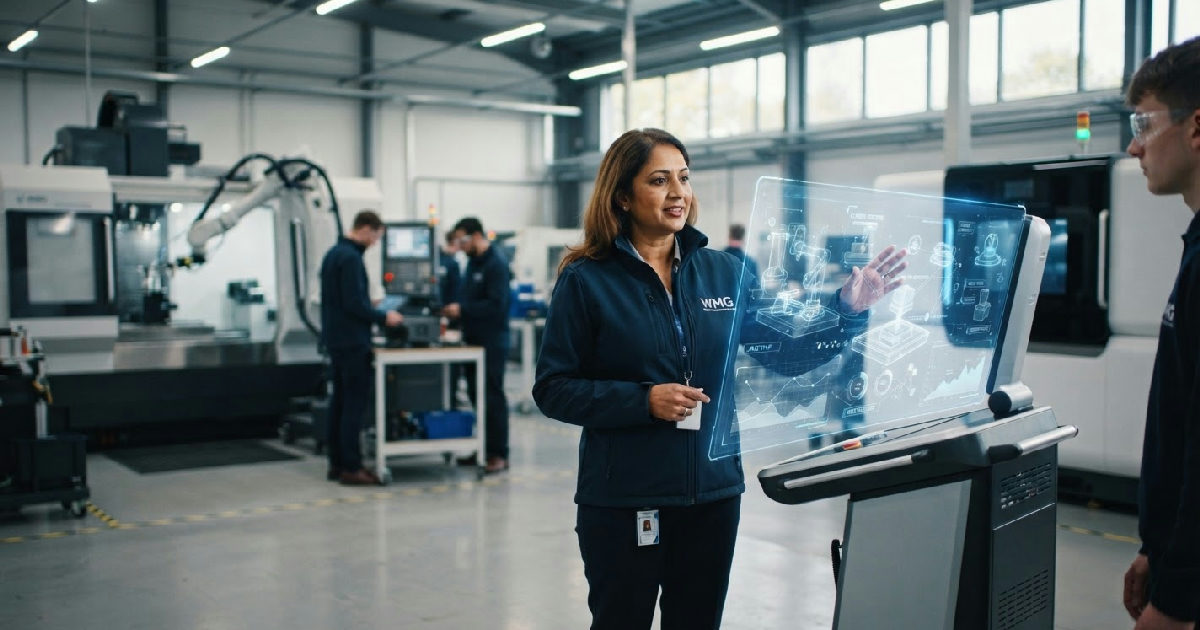
Manufacturing success rests on a multifaceted ‘hybrid’ model that extends far beyond a single technology. This approach is particularly crucial for the modern hybrid manufacturer, where digital fluency is becoming a core engineering expertise.
This shift represents one of the most significant workforce changes in decades, according to Dr Awinder Kaur, Associate Professor in Data Science and AI at Warwick Manufacturing Group (WMG), University of Warwick. The core challenge is no longer just technology adoption, but developing people who can use connected factory solutions to their full potential.
The rise of the hybrid manufacturer professional
The industry is moving away from siloed expertise towards a more integrated, collaborative future.
For generations, manufacturing was built on specialisation. Mechanical engineers focused on mechanical problems, while quality teams focused only on specifications. Digital transformation has collapsed these boundaries. Today’s connected production environments generate vast quantities of operational data from sensors, live dashboards, and AI-driven quality control, demanding a new type of employee.
Dr Kaur describes this new professional as a ‘hybrid manufacturer’. This individual is not expected to be an expert in everything. Instead, they possess deep expertise in their core discipline, such as engineering, augmented with a strong understanding of digital technologies, data, and business strategy. It’s a concept she terms “digital skills stacking,” where complementary skills allow professionals to work confidently across disciplines.
“The competitive advantage comes from combining skills, not simply accumulating experience in only one area,” Dr Kaur explained. This means engineers must understand the data from the machines they maintain, and production managers must interpret digital dashboards to find efficiencies.
This hybrid capability is crucial for complex, cross-functional tasks like deploying new systems for AI-driven maintenance, which require collaboration between engineering, software specialists, and business leadership.
This cultural shift moves away from expecting every engineer to become a data scientist. The goal is to build enough digital capability across the workforce to improve collaboration and decision-making. “Manufacturing expertise plus digital capability results in greater value,” Dr Kaur noted, creating teams that can effectively solve problems that no longer fit neatly into one department.
Hybrid processes: uniting additive and subtractive manufacturing
Beyond human skills, the hybrid concept is reshaping the factory floor itself. Hybrid manufacturing integrates additive processes, like 3D printing, with subtractive processes, such as CNC milling or grinding, often within a single machine or workflow. This advanced production process solves a long-standing dilemma, combining the design freedom of additive methods with the precision of traditional machining.
This integrated system allows engineers to first build a component to its basic shape through 3D printing, then use subtractive tools to achieve precise dimensions and fine surface finishes. The entire process happens in one setup, reducing errors that can occur when parts are moved between different machines. This opens up new possibilities for complex geometries that were previously impossible or prohibitively expensive to produce.
Benefits of an integrated production model
The advantages of a true hybrid process are substantial, impacting everything from cost to environmental footprint. By depositing material only where needed, the process drastically cuts material consumption through near-net-shape fabrication. One comparative lifecycle assessment found that hybrid manufacturing can cut environmental impact by 49% on average and reduce steel consumption by roughly 70%.
It also accelerates innovation. A design and production timeline that might take over six months with traditional methods can be cut to less than two weeks for part reproduction and iteration with a hybrid machine. This speed allows for rapid prototyping and refinement, enabling engineers to pursue optimal designs that maximise performance and supply chain resiliency.
Overcoming investment and technical challenges
Despite its promise, adopting this hybrid manufacturing approach presents significant hurdles. The initial investment in hybrid machines is high, requiring specialised training to operate. A critical bottleneck is the scarcity of workers who can program these machines, which involves tool path planning and a machining background.
Currently, only a few software companies support programming for hybrid machines, posing a barrier to adoption for many manufacturers. Furthermore, questions remain about the scalability of hybrid manufacturing to meet the demands of mass production in a timely manner. While the UK’s automation adoption continues to be debated, the specific skills required for operating advanced hybrid systems are becoming a clear priority globally.
Data, not infrastructure, drives digital success
Whether discussing hybrid skills or hybrid machines, one element underpins everything: high-quality data. Dr Kaur warns that many organisations, under pressure to accelerate AI adoption, are rushing to implement artificial intelligence without first establishing a robust data foundation. This is a critical mistake that often amplifies existing problems.
“Organisations often want to begin with AI. But my advice is always start with your data,” she stated. Technology is only as good as the information it receives, and without accurate data, AI produces poor recommendations, automation becomes unreliable, and decision-making suffers. Instead of asking which AI platform to buy, leaders should first ask what business problem they are trying to solve.
If production inefficiencies are rooted in inconsistent processes or disconnected systems, adding an AI layer will not resolve the underlying issue. “AI is not a magic solution,” Dr Kaur emphasised. “Technology alone does not transform any organisation.” For this reason, data literacy—involving understanding where data originates, assessing its quality, and interpreting its meaning—is becoming one of the most vital capabilities for the entire manufacturing workforce.
Securing the increasingly connected factory floor
As operational technology (OT) and information technology (IT) converge in hybrid environments, cyber resilience has moved from being a technical consideration to a fundamental business requirement. The consequences of a successful cyber attack on a connected factory extend far beyond data loss, potentially halting production, disrupting supply chains, and damaging reputations simultaneously.
Dr Kaur believes many organisations continue to approach security too narrowly. “Cyber security isn’t just the responsibility of IT,” she argued. “Everyone plays a role; operators, engineers, managers and senior leaders.” Many risks stem not from sophisticated technical attacks but from human behaviour, such as falling for phishing attacks or entering confidential company data into public generative AI models.
As AI becomes more embedded in manufacturing workflows, clear governance must be established alongside technical controls. “Cyber security and AI go hand-in-hand,” Dr Kaur said. “You can’t do one without another.” Embedding security into digital transformation projects from the outset is essential for building trust and ensuring the long-term viability of these advanced systems.
Building the skilled hybrid workforce of tomorrow
The evolution of manufacturing roles presents employers with a pressing challenge: a significant skills gap. “The real shortage isn’t AI specialists,” Dr Kaur noted. “It’s people who can bridge engineering and digital technologies.” These individuals need a mix of data literacy, AI implementation knowledge, systems thinking, and change management skills on top of their core manufacturing expertise.
This reality raises a key question for employers: recruit entirely new talent or upskill the existing workforce? Dr Kaur strongly advocates for the latter. “I would prioritise developing existing employees,” she said. “Existing staff already understand manufacturing processes, products, customers and organisational culture. Those aspects are extremely valuable.”
Decades of hands-on manufacturing experience cannot be taught quickly, but digital skills often can be added. This blending of experience with digital skill is crucial for solving complex, cross-functional problems, whether implementing predictive maintenance or managing connected operations. Manufacturers that successfully combine experienced operational staff with targeted digital upskilling are building workforces that are far more resilient than those relying solely on external recruitment.
The factory of the future will contain more connected systems and more intelligent automation than ever before. But these technologies will only deliver their full potential if the people using them possess the skills to interpret the data, question the outputs, collaborate across disciplines, and continue learning as technology evolves.
Ultimately, the competitive advantage will belong to manufacturers capable of developing this curious, adaptable, and hybrid workforce.
