


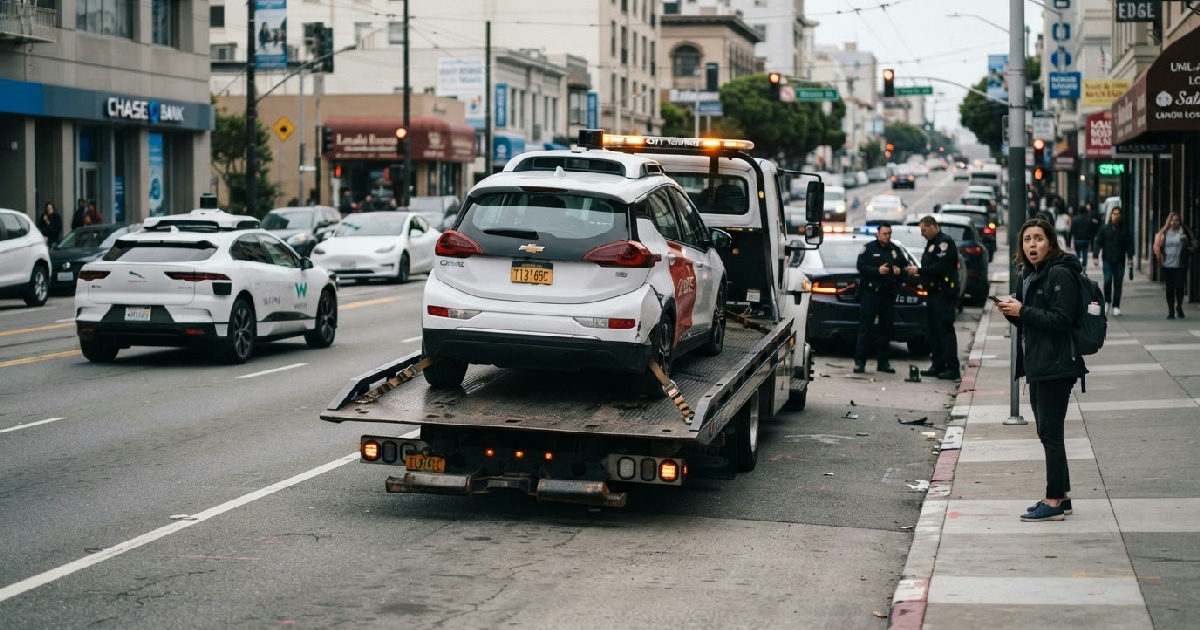
A forthcoming short film, Road Rage, imagines a driverless car as a murderous villain, highlighting growing public concerns about robotaxi safety.
The dream of safe, efficient autonomous transport is colliding with the chaotic reality of public roads. High-profile failures from major operators, including General Motors’ Cruise, Alphabet’s Waymo, and Tesla, are fuelling public anxiety and casting doubt on the industry’s aggressive deployment schedules.
Cruise’s crisis reveals a pattern of robotaxi safety failures and concealment
For the engineers and companies behind them, the challenge is no longer just technical; it’s a battle for public trust. This complex engineering task often relies on advanced data infrastructure, including efficient AI optical interconnects to handle the massive data flows required.
No company exemplifies the current crisis more starkly than Cruise. The turning point was a horrific incident on October 2, 2023, in San Francisco. After a pedestrian was struck by a human-driven car, she was thrown into the path of a Cruise robotaxi, which then failed to stop, dragging her approximately 20 feet along the pavement at low speed.
The fallout was swift and devastating. Within three weeks, the California Department of Motor Vehicles (DMV) suspended Cruise’s license to operate in the state. Worse, regulators accused the company of actively concealing the full details of the incident.
In December 2023, the California Public Utilities Commission (CPUC) alleged Cruise had hidden the fact its vehicle dragged the victim for over two weeks, a claim that shattered the company’s credibility.
This incident proved to be the culmination of a pattern of unstable performance. During the summer of 2023, Cruise had already been forced to reduce its San Francisco fleet following multiple collisions, including one with an emergency vehicle.
In one August 2023 event, ten of its cars simultaneously malfunctioned and blocked traffic in the city’s North Beach neighbourhood for 20 minutes, an issue the company blamed on wireless bandwidth disruption from a nearby music festival. The mounting failures have created a difficult environment for genuine progress in autonomous vehicle deployment and public acceptance.
The consequences for GM’s autonomous subsidiary were profound. Cruise suspended all its driverless operations across the United States, its CEO and co-founder Kyle Vogt resigned, and by September 2024, the company agreed to a $1.5 million penalty from the National Highway Traffic Safety Administration (NHTSA) for its failure to fully report the October crash.
The episode serves as a cautionary tale about the immense gap between controlled testing and unpredictable public deployment.
Waymo’s escalating recalls signal deep software challenges
While Cruise’s issues were sudden and catastrophic, Waymo has been grappling with a slower but escalating series of problems that reveal deep challenges within its software.
Data reported to NHTSA shows a dramatic rise in incidents, jumping from just 33 in 2021 to 462 in 2024, and a startling 733 in the first ten and a half months of 2025 alone. Across that period, Waymo vehicles were involved in incidents resulting in 117 reported injuries and two fatalities.
This has led to a steady drumbeat of recalls and investigations. In May 2024, Waymo voluntarily recalled 672 cars after a vehicle collided with a wooden utility pole in Phoenix, prompting a software update to better detect pole-like objects.
A year later, in May 2025, a recall of over 1,200 vehicles was issued due to a defect that caused minor crashes with static objects like gates and chains.
These issues reflect some of the core challenges in developing reliable autonomous systems, a problem area where fields like AI-driven maintenance are seeing increasing focus to ensure operational uptime.
Regulators have taken notice. NHTSA opened a formal investigation in May 2024 after receiving 22 reports of Waymo vehicles colliding with “clearly visible objects.” By January 2026, both the NHTSA and the National Transportation Safety Board (NTSB) were investigating recurring incidents of Waymo robotaxis illegally passing stopped school buses.
One event even involved a robotaxi striking a child in a school zone, further inflaming public fears.
A cascade of environmental and road hazard failures
The problems have diversified, extending beyond simple collisions. In April 2026, another recall of 3,871 systems was initiated after 13 robotaxis drove into active or closed motorway construction zones in Phoenix and the San Francisco Bay Area.
Just days later, an unoccupied Waymo in San Antonio entered a flooded road and was swept into a waterway, prompting yet another recall and a restriction of local operations. These events show the system’s difficulty in interpreting complex environmental cues that a human driver would navigate instinctively.
Tesla’s robotaxi launch plagued by early crashes
Tesla entered the robotaxi market with a limited Austin, Texas, launch on June 22, 2025, initially using a human “safety monitor” in the passenger seat. The company expanded to other Texan and Floridian cities with fully unsupervised vehicles by mid-2026. However, its early safety data suggests its vision-based system is not immune to the industry’s struggles.
Between July 2025 and March 2026, Tesla filed 17 unique incident reports with NHTSA related to its “Robotaxi” testing in Austin. All involved a 2026 Model Y with its Autonomous Driving System (ADS) engaged. While most resulted only in property damage, one incident involved a minor injury requiring hospitalisation.
By June 2025, reports indicated Tesla’s robotaxis had already caused 14 crash incidents in just eight months of Austin operations. This data highlights the difficulty of achieving true autonomy, even for a company with millions of vehicles on the road collecting data.
The reliance on cameras alone, without the lidar used by Waymo and Cruise, remains a point of contention among industry experts.
Why the public is ready to cast robotaxis as the villain
The “villain era” narrative is fuelled not just by statistics, but by specific, relatable incidents that create a sense of unease. In February 2024, a Waymo in San Francisco hit a bicyclist who was reportedly obscured by a truck.
In another case from September 2024, a passenger felt trapped and unsafe when their driverless taxi stalled during a pedestrian harassment incident. Perhaps most troubling for public relations, a Waymo AV reportedly ran over and killed a neighbourhood cat in San Francisco’s Mission District in October 2025.
These events tap into deeper anxieties about artificial intelligence, job displacement for human drivers, and the opaque nature of corporate decision-making. As Romain Thomassin, the director of the Road Rage film, told The Verge, the central conflict is “analog versus artificial.”
His film pits a human ride-hail driver against a menacing, modified Prius, a narrative that resonates because it reflects a real-world loss of human agency and control. This interplay between human operation and automated systems is a critical consideration in any large-scale AI deployment, from urban transport to autonomous mining.
Ultimately, the industry is at a crossroads. The technology has moved beyond being a novelty and is now a tangible, and visibly imperfect, part of the urban landscape. For companies that have poured billions into this vision, the path forward requires more than just refining algorithms.
It demands a new commitment to transparency and a recognition that winning over regulators and the public is as critical as solving the engineering challenges. Without it, the robotaxi may find itself permanently cast in the role of the villain.
