


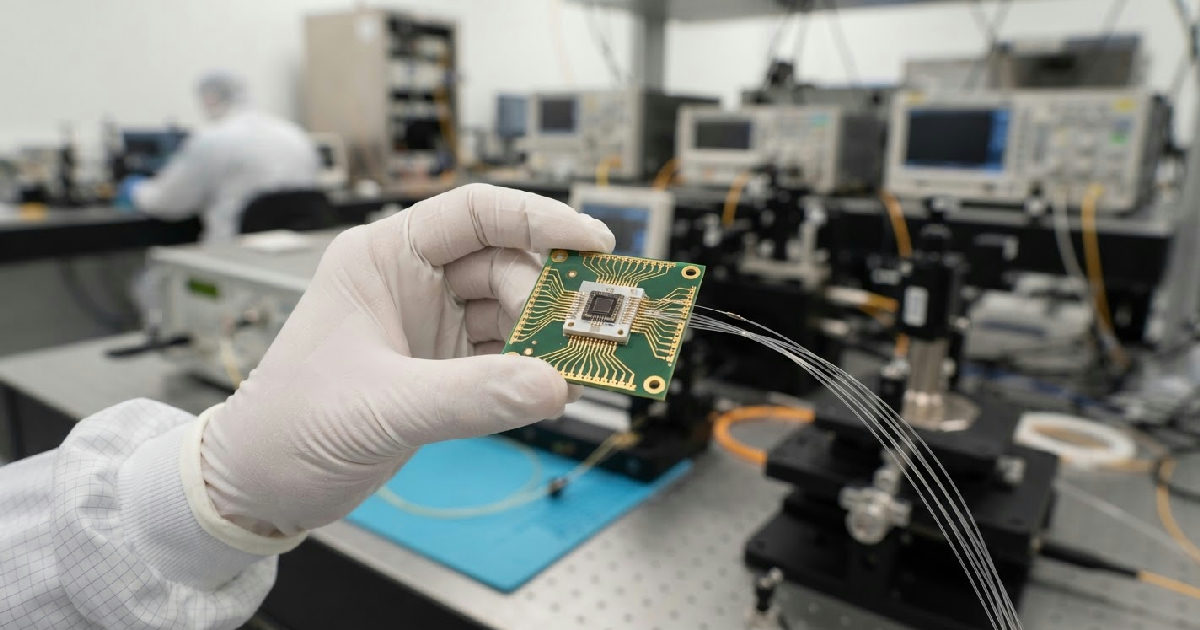
Optical interconnect products for AI datacentres have secured $40 million in an oversubscribed Series A investment round.
The funding, announced on Monday, 24 August 2026, coincides with the company initiating customer sampling for its inaugural product: a single-chip quantum dot-based Dense Wavelength Division Multiplexing (DWDM) comb laser. This move marks a critical step towards addressing the escalating power demands and data bottlenecks within rapidly expanding AI infrastructure.
AI optical interconnects for data bottlenecks
The explosive growth of artificial intelligence has placed immense pressure on existing data centre infrastructure. This is particularly true concerning the movement of vast quantities of data between computing units.
Conventional electrical interconnects face limitations in signal integrity, power consumption, and thermal management. Optical interconnects, leveraging lasers and fibre optics, offer a pathway to higher bandwidth and lower latency.
However, the rapid expansion has created a twin challenge for the industry. There’s a global scarcity of Indium Phosphide (InP), a vital material for current lasers, alongside the inherently high energy consumption of existing optical components.
Single-Chip Comb Laser Design
Quintessent’s engineering approach tackles both problems by integrating eight separate lasers onto a single chip. This innovative quantum dot-based DWDM comb laser generates eight precisely spaced wavelengths from one unified control.
The design simplifies optical system architecture, reducing discrete components and potential points of failure. This integration also streamlines control mechanisms, contributing to greater overall system stability for AI optical interconnects.
Scaling Production with Novel Materials
The company’s technology relies on Gallium Arsenide (GaAs) O-band quantum dot gain material. This is heterogeneously integrated onto standard silicon photonics, a choice crucial for scaling production effectively.
By utilising readily available, high-volume materials and standard chip-making tools, Quintessent aims to sidestep the supply chain constraints currently impacting the optical interconnect market. This strategy is essential for meeting the anticipated demand for millions of lasers as AI deployment continues.
This architectural decision facilitates high-volume, wafer-scale manufacturing, a necessity for keeping pace with the exponential growth in AI data centre requirements. The ability to produce these components efficiently and at scale directly addresses a major industrial bottleneck, echoing the benefits of a modular manufacturing approach.
Reducing the Energy Footprint of AI Datacentres
The energy footprint of AI datacentres has become a pressing concern for engineers and operators alike. Moving data within these facilities accounts for a substantial portion of their electricity consumption, contributing to significant operational costs and environmental impact.
Quintessent’s single-chip design directly targets this issue. The company claims its technology can reduce the power required for data movement by up to 40% when compared to current setups, marking a substantial improvement.
Investor Focus on Energy Efficiency
Andrée-Lise Méthot, Founder and Managing Partner of lead investor Cycle Capital, highlighted the urgency of this challenge. She noted that AI’s acceleration of data centre demand places considerable pressure on global power systems.
The projected doubling of electricity consumption from data centres to approximately 945 Terawatt-hours (TWh) by 2030 underscores this pressure. AI alone consumed an estimated 0.5% of the world’s electricity in 2025, signalling a critical trend for engineers.
This commitment from Cycle Capital reflects a broader investment trend towards AI engineering platforms and technologies. These solutions promise both performance gains and environmental benefits as engineers increasingly seek to balance computational power with energy efficiency.
Optical I/O Market Growth
The shift towards optical interconnects is not merely about speed; it is fundamentally about efficiency. As the bottleneck in large-scale computing moves from GPUs to data transmission, optimising every aspect of data movement becomes paramount.
The global in-package optical I/O market, valued at just over $32 million in 2024, is forecast to exceed $540 million by 2032. This rapid expansion, at a Compound Annual Growth Rate (CAGR) above 40%, signals a major industrial transition.
Silicon photonics, a core element of Quintessent’s design, is also experiencing a boom. The market, valued at $2.65 billion in 2025, is projected to reach $9.65 billion by 2030, driven by the demand for high-speed, energy-efficient solutions in AI datacentres.
Company Growth and Strategic Investment
The $40 million Series A funding will allow Quintessent to move beyond laboratory development and accelerate its transition into a product-focused company. The capital will primarily be allocated to further mature the comb laser technology.
This includes extensive sampling, reliability testing, and qualification processes essential for large-scale deployment. The company will also ramp up manufacturing capabilities, ensuring it can meet anticipated customer demand.
The investment will also fund the development of other critical optical components. This includes semiconductor optical amplifiers and complete optical engines for high-reliability, availability, and serviceability pluggable module interconnect applications.
Backing from Leading Investors
The funding round saw Cycle Capital take the lead. New investors like Goldman Sachs XIG-Industry Ventures, Hina Liberty Capital, Susquehanna International Group, InterVest, Safar Partners, and Ciena joined the round.
Existing investors including Foothill Ventures, M Ventures, Osage University Partners, and Sierra Ventures also participated. Their continued backing underscores confidence in Quintessent’s technology.
The involvement of Ciena, a major player in intelligent networking and optical transport, is particularly noteworthy. It suggests a strategic alignment with industry leaders who integrate foundational chip startup funding to enhance network performance and automation.
Origins and Future Vision
Quintessent was founded in 2019 by Alan Liu, CEO, and Professor John Bowers, emerging from research at the University of California, Santa Barbara. Professor Bowers is a prolific inventor who has co-founded five photonics-related startups.
Alan Liu’s background includes work as a technology consultant for the Defense Advanced Research Projects Agency (DARPA) and the Advanced Research Projects Agency-Energy (ARPA-E). He advised on optical interconnect research and development programmes, bringing significant expertise.
The company’s mission is to simplify the optical infrastructure for the AI era. They aim to enable resilient and scalable AI connectivity by converging innovations in materials science, process, manufacturing, and device design.
Quintessent first unveiled its comb laser technology earlier in 2026 with live demonstrations to select customers and partners at OFC 2026. This industry optical networking conference marked a significant debut, confirming that communication, not computation, is the current system-level bottleneck in large-scale computing and AI applications.
