


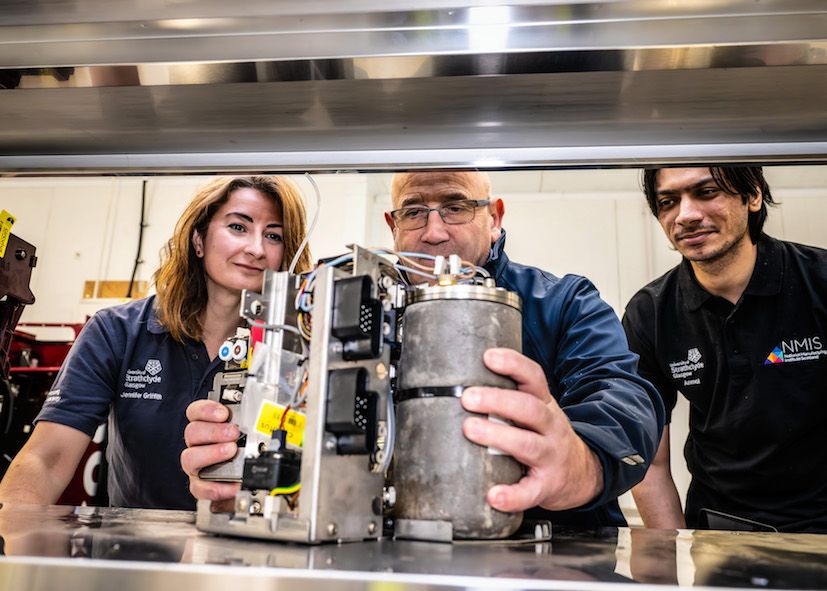
The National Manufacturing Institute Scotland (NMIS) and Glasgow-based circular economy specialist Circulus CRM have concluded a six-month trial demonstrating the real-world viability of digital product passport (DPP) technology for remanufacturing electrical equipment.
Engineers and manufacturing professionals worldwide are increasingly seeking practical solutions to address regulatory pressures and resource scarcity. The trial, conducted within Circulus’s own operational environment, demonstrated that digital product passports can be integrated without disrupting day-to-day business activities.
Testing digital product passports in practice
The trial marks a significant step towards more transparent and sustainable industrial practices, according to Awais Munawar, Digital Team Lead – Digital Factory at NMIS, and Gerry Docherty, Managing Director of Circulus.
The six-month project focused on integrating digital product passports into Circulus CRM’s core business operations. Circulus, which specialises in extending the life of electrical equipment through repair, refurbishment, and remanufacturing, provided a crucial real-world environment for the trial. Its work keeps valuable products in circulation for longer, directly reducing landfill waste.
NMIS collaborated closely with Circulus, first mapping the intricate flow of information across the company’s operations. This critical step identified how product data was being handled and, more importantly, where it could be captured and shared more efficiently and accurately. The objective was to create a comprehensive digital footprint for each electrical asset.
To avoid any disruption to Circulus’s live operations, the team built a replica of the company’s HIVE business management system. This simulated environment allowed the team to rigorously test the digital product passport platform under real-world conditions. This meant the technology could be refined before being deployed in active manufacturing workflows.
NMIS’s digital product passport platform then linked electrical assets to secure digital records using QR codes. Authorised users could access detailed information about a product at any stage of its lifecycle, whether it was undergoing repair or refurbishment or being prepared for recycling. This level of traceability is fundamental for optimising remanufacturing processes.
The broader mandate for product data transparency
Digital product passports are much more than a convenience; they represent a fundamental shift driven by increasingly stringent global regulations, particularly in the European Union. Often described as a “digital record” or “digital identity card” for physical products, a DPP stores critical information about a product’s history.This includes manufacturing details, materials used, repair history, and instructions for end-of-life processing.
The EU Green Deal, which first introduced the concept in 2019, has been a major catalyst. Digital product passports are now a mandatory component of the Ecodesign for Sustainable Products Regulation (ESPR) and the Circular Economy Action Plan (CEAP).
The ESPR, which came into force on July 18, 2024, replaced the earlier 2009 Ecodesign Directive, significantly broadening the scope of the rules to nearly all physical products on the EU single market.
This regulatory framework aims to enhance product durability, reusability, and reparability, while also improving energy and resource efficiency. Crucially, it pushes for increased recycled content and simplified processes for remanufacturing and recycling. These measures are designed to help the EU achieve climate neutrality by 2050.
Driving circular economy goals with digital product passports
The immediate impact of digital product passports will be felt in industries such as battery manufacturing, with mandatory implementation for relevant battery products beginning in 2027. More than 30 other product groups, including textiles, construction materials, and consumer electronics, are expected to follow in subsequent years. This phased rollout gives industries time to adapt but underscores the inevitability of this change.
Digital product passports provide comprehensive information to a range of stakeholders: consumers can make more informed choices, manufacturers can optimise design for circularity, repair services gain access to essential diagnostics, and recycling companies receive crucial data on valuable or hazardous substances. This transparency is key to enabling “R-strategies”, such as reuse, repair, and remanufacturing.
The need for such tools is clear when examining global circularity trends. Data indicate a concerning decline in global circularity, from 9.1% in 2018 to 8.6% in 2020 and further to 7.2% in 2023. These figures highlight a persistent challenge in retaining materials and products in use. Digital product passports offer a mechanism to counteract this trend by boosting material and energy efficiency and extending product lifetimes.
Moreover, DPPs can simplify compliance with evolving environmental standards and provide auditors with verifiable information. For high-integrity sectors such as aerospace, defence, and energy, where precise product histories are paramount, digital product passports offer a robust solution for tracking components and ensuring safety and performance across multiple lifecycles. This also helps reduce uncertainty in certification processes.
Industrial impact and future steps
The Glasgow trial demonstrates that digital product passport technology can be successfully embedded into existing remanufacturing operations. It directly addresses long-standing challenges in the sector, such as demand uncertainty, variability in product quality, and a general lack of accessible product data, which can lead to manual and less efficient processes.
Customer feedback from the trial indicated strong interest in the benefits provided by the technology. This suggests a receptive market for solutions that improve product transparency and support sustainability.
For businesses such as Circulus, which are built around the principles of repair and reuse, the ability to track a product’s journey from design through its working life and ultimately to end-of-life processing is highly valuable.
This enables them to make more informed decisions about how and when to intervene in a product’s lifecycle, helping keep products in use for longer.
Following this initial success, Circulus and NMIS plan to move into a second phase. This will involve piloting the system with major clients, allowing for real-world deployment on a larger scale. The feedback from these larger commercial applications will be critical for refining functionality and demonstrating broader applicability. The initiative is also actively seeking further funding to support its scale-up, indicating confidence in its commercial potential.
Accelerating industrial digitalisation across sectors
The work undertaken by NMIS and Circulus reflects a wider push towards greater industrial digitalisation. This effort is not solely about sustainability; it is also about unlocking efficiencies and creating new value streams in manufacturing. Digital product passports provide precise, verifiable records that are critical for complex industries, particularly high-integrity sectors such as aerospace, defence, energy, and wind power, where meticulous component tracking and lifecycle data management are essential.
The National Manufacturing Institute Scotland itself developed the ReMake Digital Product Passport platform specifically for these demanding environments. The integration of such digital tools supports meticulous tracking of components, materials, and processes, helping ensure regulatory compliance and enhancing the overall resilience of supply chains. For example, the precise management of intricate components in power generation and aerospace requires granular data throughout a product’s lifespan.
These digital identities can track everything from raw material origins to repair history, providing a clear record of a product’s lifecycle. They can support predictive maintenance, accelerate certification processes, and streamline remanufacturing pathways. Ultimately, digital product passports contribute to a more transparent and accountable manufacturing ecosystem, which is increasingly vital for sectors such as home battery production.
Wider regulatory compliance and market advantages
The adoption of digital product passport technology presents both challenges and significant opportunities for manufacturers globally. While immediate regulatory pressure for DPPs originates primarily from the European Union, the regulatory shift clearly signals a worldwide trend towards greater product transparency and circularity.
Businesses aiming to export to European markets may need to comply with the requirements of the Ecodesign for Sustainable Products Regulation (ESPR), making early adoption a strategic advantage.
Fundamentally, this technology enhances industrial capabilities worldwide. By enabling better tracking and management of components, especially in the remanufacturing sector, businesses can improve resource efficiency and potentially reduce reliance on new materials. This supports the growth of local repair and remanufacturing activities, while fostering technical expertise and creating value within regional economies.
The EU’s ESPR, which has been in force since July 18, 2024, applies to nearly all physical products on the single market, with mandatory digital product passports for batteries set to take effect by 2027. This regulatory shift impacts global supply chains, pushing manufacturers everywhere to prepare for comprehensive product data management. It also gives customers greater insight into the environmental impact of the products they purchase, promoting more informed decision-making.
