


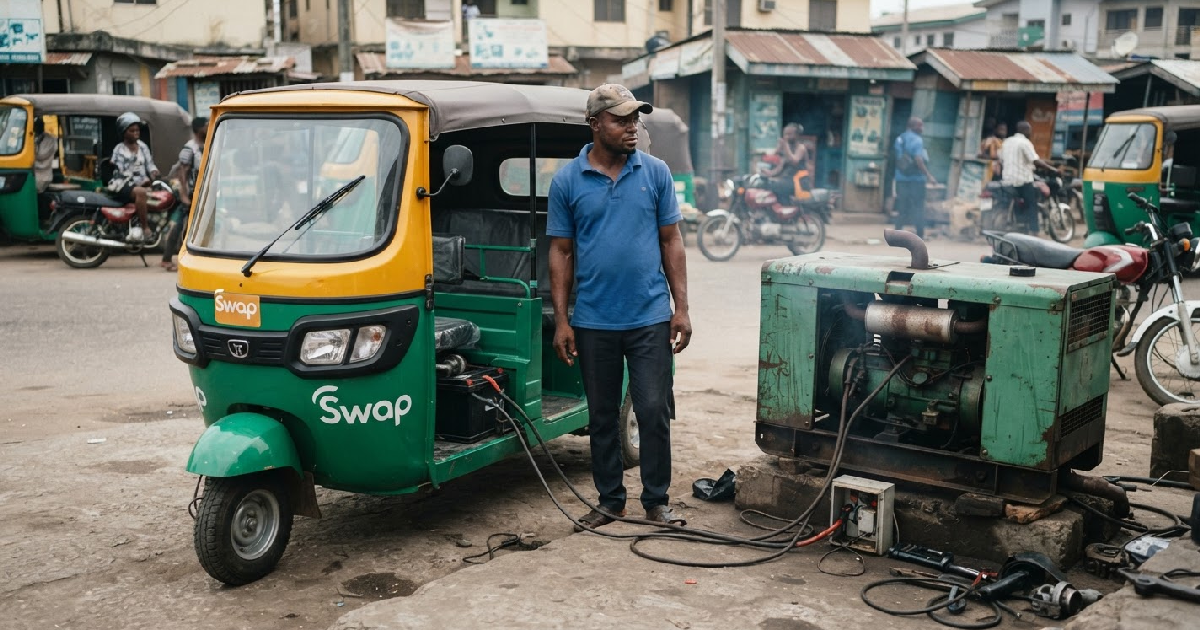
Lagos, Nigeria — A quiet revolution is underway on the streets of Lagos, where thousands of petrol-powered commercial three-wheelers, known locally as kekes, are converting to electric motors. This shift, driven by startups like Swap, promises significant cost savings for drivers like Moses and Anthony Adiku, who battle escalating fuel prices and persistent maintenance issues.
But the electrification journey isn’t without its ironies; the unreliable national grid often means that the battery swapping stations powering these new electric fleets rely heavily on diesel generators for charging, creating an intricate engineering and logistical challenge that directly impacts drivers’ livelihoods.
The challenge of charging electric three-wheelers in Nigeria
Commercial three-wheelers became a mainstay of Lagos transport after the government restricted commercial motorcycles in 2020. These agile vehicles navigate the city’s congested, narrow roads, providing essential last-mile connectivity for its 17 million residents.
Swap, a Nigerian startup founded in May 2024 by Timilehin Odusina, Seyi Oguntunde, and Emmanuel Marchie, offers a compelling proposition: they remove a keke‘s existing petrol engine and replace it with an electric motor powered by swappable lithium batteries. Crucially, they do this at no upfront cost to the driver.
Moses, a driver who converted his keke two years ago after his petrol engine failed, hasn’t needed a mechanic since. He regularly visits one of Swap’s five stations in Lagos to exchange depleted batteries for charged ones, a process taking less than two minutes. This rapid turnaround allows him to keep earning without the downtime of traditional charging.
Anthony Adiku, another driver, converted his keke in December 2025 because maintenance costs on his old engine became prohibitive. He now uses two batteries daily, spending about ₦6,000 ($4.36) and earning around ₦15,000 ($10.89) over a 12-hour shift. The biggest benefit, he notes, is the consistent operational reliability, freeing him from mechanical worries.
The diesel dilemma in charging infrastructure
While the goal is cleaner transport, the reality of Nigeria’s power supply means many electric vehicle (EV) charging stations depend on diesel generators. At Swap’s Ikorodu station, for example, two generators run almost continuously to charge batteries, a necessity since the station lost grid power in January 2026.
Victor Oguare, the Ikorodu station manager, confirmed they charge between 90 and 100 batteries daily. Keeping these generators running requires significant diesel consumption. Swap purchases 1,000 litres of diesel every three to four days, costing roughly ₦1.95 million ($1,450) at current retail prices of ₦1,750 ($1.28) per litre.
This translates to an estimated monthly expense of ₦14.6 million to ₦19.5 million ($10,900 to $14,500) just for fuel.
This reliance on generators drastically reduces charging efficiency. A generator-powered station operates at about a third of the output of a grid-connected one. Charging 40 to 50 batteries takes nearly two and a half hours, compared to 90 batteries in 90 minutes with grid power. This capacity constraint creates significant issues for drivers.
Paul, an Ikorodu-based driver, experiences these shortages directly. He often waits hours for batteries, sometimes receiving only two or three instead of the four he needs for a full day’s work. His daily hire-purchase fee of ₦7,500 ($5.61) remains constant, but his earning window shrinks, often leaving him with little to no profit.
He’s even had to push his keke after running out of battery mid-route.
Engineering the battery swapping solution
Swap’s founders pivoted to electric three-wheelers after an earlier venture selling inverters highlighted that cost, not climate, drives adoption in Nigeria. Recognising that power would become more expensive, they saw an opportunity in affordable transport solutions.
Their prototype development between 2020 and 2021 was rigorous. They purposely selected the most dilapidated keke they could find – one that had spent its life hauling cement – to ensure their conversion kit would work on any vehicle. After some early battery explosions during testing, they achieved their desired speed and mileage by 2022.
The company views its battery technology as a core advantage. While specific power ratings are proprietary, Swap collaborated with a manufacturing partner on materials suited to Nigerian conditions, developing its battery management system in-house. Each battery is projected to last about five years, with existing units showing minimal degradation after three years in the field.
The conversion process itself is a coordinated engineering effort. Emmanuel, a technician, can convert two kekes in about 90 minutes with a three-person team.
This involves removing the petrol engine, stripping the vehicle to its frame, wiring in the new electric motor, installing a digital monitor, securing the motor housing by a welder, and finally, a mechanic setting the engine in place.
Emmanuel, who has converted over 50 kekes since September 2025, highlights the welder’s critical role in this sequential operation, earning between ₦80,000 ($58) and ₦100,000 ($72.6) monthly for his skilled work.
Economic drivers and scaling challenges
Swap’s business model centres on asset financing. They absorb the upfront conversion cost, recovering it as drivers pay for battery swaps. Drivers average 2.5 swaps daily, some doing up to four, indicating high utilisation rates.
The primary draw for drivers isn’t just fuel savings, but also reduced maintenance costs. Drivers reported spending between ₦50,000 ($36) and ₦90,000 ($65) monthly on engine upkeep and repairs before converting. Swap estimates its solution offers around 50% savings when factoring in both fuel and maintenance, a gap that has widened with petrol price hikes.
Nigeria’s electric vehicle adoption efforts could see further momentum from such economic incentives.
Swap has converted just over 300 tricycles and has another 1,000 conversion kits on order. However, this is a small fraction of the over 100,000 tricycles on their waitlist. The significant gap highlights a critical constraint: capital. Each conversion is an asset requiring financing before it generates revenue, underscoring the need for debt capital to scale operations.
To overcome this, Swap plans a hub-and-spoke model, with 10 depots by late 2026 for large-scale battery recharging, supplying smaller, local swapping stations. They also envision a franchising model for these spokes, allowing other operators to own and run them, much like the early rollout of petrol stations established a distributed infrastructure before broader adoption.
Broader landscape of electric keke adoption
Swap is not alone in the drive to electrify Nigeria’s last-mile transport. Several other players are actively building out the infrastructure. Ecowaka Limited launched its three-wheeled electric vehicles on July 4, 2025, offering new units from ₦2.6 million and conversion solutions from ₦2.3 million.
Their vehicles feature an 8kWh battery, a top speed of 50 km/h, and a range of up to 120 km per charge, with battery swaps taking less than five minutes.
Mataji Express, in partnership with the National Automotive Design and Development Council (NADDC), unveiled its conversion initiative on February 23, 2025. These converted tricycles use five 12-volt, 20-amp deep-cycle batteries, generating 1.2 kilowatts of power, and can travel between 95 and 120 km on a single charge. Charging these units under Nigeria’s Band A electricity tariff costs approximately ₦270–₦275 (£0.25) for a 90-kilometer range.
Other companies like Bolt, MAX, Spiro, Qoray, and Siltech are also investing in battery swap infrastructure. Bolt launched 25 electric kekes in April 2025 with a lease-to-own model. Revive Earth, founded in 2021 by Chukwuemeka Eze, converts existing fuel-powered vehicles and assembles battery packs in Enugu.
KGR Partners in Kaduna designs and builds electric tricycles using local materials and operates its own off-grid solar charging stations, demonstrating an alternative to diesel reliance. Reliable electricity access is a recurring theme for industrial development across Nigeria.
The “robot keke” and societal impact
Drivers have affectionately dubbed Swap’s electric tricycles “robot kekes,” seeing them as a glimpse into the future. This informal naming reflects the genuine appeal of the technology for those who rely on it for their livelihoods. For these drivers, the shift is more than just about technology; it represents stability.
The reliance on Swap’s batteries means drivers are deeply integrated into the company’s ecosystem. If a station runs out of batteries, drivers cannot work, impacting their daily income. This highlights the profound social responsibility companies like Swap carry; a failure in their logistics could strand hundreds of thousands of people whose families depend on their daily earnings from these vehicles.
Moses, who has operated his converted keke for two years, and Paul, who hands over ₦7,500 ($5.45) daily to a fleet owner, represent countless individuals whose economic well-being is now tied to the efficiency of battery swapping operations. Their experiences underscore the real-world implications of infrastructure reliability.
The engineering imperative: sustainable power solutions
The widespread adoption of electric three-wheelers in Nigeria offers clear economic and environmental advantages, particularly given the rising cost of petrol. However, the current reliance on diesel generators for charging infrastructure in many areas presents a significant engineering paradox, undermining the environmental benefits and adding operational costs.
The challenge for companies like Swap and the broader Nigerian infrastructure development landscape is to transition to more sustainable and reliable power sources. The examples set by KGR Partners and Qoray, who have developed off-grid solar charging stations in Kaduna and Kano, offer a viable path forward.
These initiatives demonstrate that local, renewable energy solutions can bypass the unreliable national grid, ensuring consistent power for EV charging.
Moving forward, the success of electric three-wheelers in Nigeria hinges not just on the vehicles themselves, but on building a resilient, green charging infrastructure. This will require continued engineering innovation in battery technology, smart grid integration, and decentralised renewable energy solutions to truly deliver on the promise of affordable, clean transport.
