


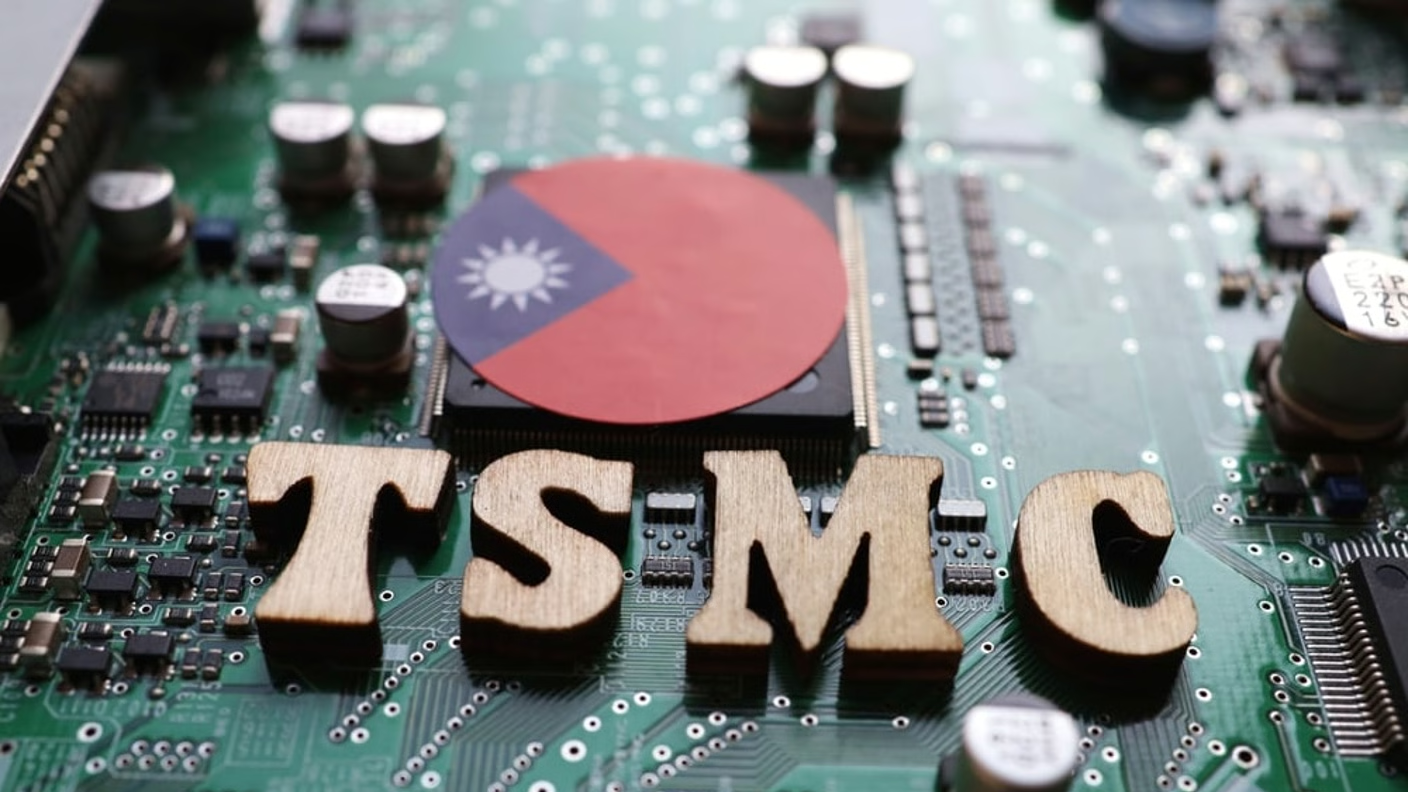
Taiwan Semiconductor Manufacturing Company (TSMC) has committed an additional $100 billion to its United States operations, bringing its total planned investment in the country to $265 billion.
This massive infusion of capital will expand the chip giant’s footprint in the US to 12 facilities, predominantly located at its growing campus in Greater Phoenix, Arizona. The announcement came on July 16, 2026, during TSMC’s second-quarter earnings conference in Taipei, with CEO C.C. Wei citing soaring demand from artificial intelligence (AI) customers as a primary driver.
Arizona’s expanding chip manufacturing hub
The latest funding round specifically targets the construction of up to four new advanced chip fabrication plants, known as fabs, and advanced packaging facilities. This takes the total US facilities to 10 semiconductor manufacturing fabs, two advanced packaging facilities, and a dedicated research and development centre, all concentrated in Arizona.
These new fabs will focus on producing cutting-edge chips at the 2-nanometer (nm) node and even smaller, along with crucial advanced packaging. This technological capability is essential for the high-performance computing required by today’s data centres and AI applications.
escalating capital expenditure and production timelines
TSMC has revised its 2026 capital budget upward, now estimating it will spend between $60 billion and $64 billion, an increase from its earlier projection of $52 billion-$56 billion. This significant boost reflects the urgent and considerable investment required to scale up advanced manufacturing capabilities.
Production at the first Arizona fab, focused on 4-nanometer chips, began in the fourth quarter of 2024, reportedly achieving yields comparable to TSMC’s established Taiwan facilities. The second Arizona facility aims to commence manufacturing more advanced 3-nanometer chips in the latter half of 2027.
Plans for 2-nanometer and below production are targeting a 2029 rollout. However, the exact timeline for these new fabs will remain subject to “market conditions” and the “market situation,” as noted by TSMC CEO C.C. Wei.
driving demand from artificial intelligence
The primary impetus behind this monumental TSMC US semiconductor investment is the “insatiable AI demand” currently sweeping the technology sector. Companies like Nvidia and AMD are pushing the boundaries of AI, requiring ever more powerful and complex chips.
This escalating demand for specialised computing power from data centres necessitates a robust and geographically diversified supply chain. Localising a significant portion of this advanced manufacturing capability becomes a strategic imperative for the US.
strategic importance of advanced packaging
The expansion isn’t just about chip fabrication; it also includes critical advanced packaging facilities. Advanced packaging techniques are vital for integrating multiple chips into a single, high-performance unit, which is fundamental for modern AI accelerators.
Without sophisticated packaging, even the most advanced raw chips cannot achieve their full potential. Investing in these facilities alongside fabs ensures a comprehensive ecosystem for next-generation AI hardware.
US industrial policy and CHIPS Act support
This historic investment is inextricably linked to the United States’ concerted effort to revitalise its domestic semiconductor industry, largely spearheaded by the CHIPS and Science Act. Signed into law by President Joe Biden in August 2022, the Act authorises around $280 billion in funding to boost semiconductor research and manufacturing.
Specifically, it allocates $39 billion in subsidies for chip manufacturing and offers 25% investment tax credits for manufacturing equipment costs. This legislative backing aims to reverse a trend where the US share of global semiconductor manufacturing fell from 37% in 1990 to just 10% by 2022.
significant government backing and job creation
TSMC has received substantial government support, including $6.6 billion in direct funding and an additional $5 billion in loans under the CHIPS Act. This financial assistance underscores the US government’s commitment to securing its semiconductor supply chain.
The investment is also projected to have a profound economic impact, with U.S. Commerce Secretary Howard Lutnick estimating the creation of “tens of thousands of American jobs.” Beyond direct employment, the TSMC Arizona campus is forecast to generate over $200 billion in indirect economic output across the state over the next decade.
geopolitical shifts and supply chain resilience
This massive foreign direct investment, described as the “largest single foreign direct investment in U.S. history,” reflects a broader geopolitical strategy. The US aims to reduce its dependence on overseas manufacturing, particularly from regions perceived as geo-politically sensitive.
A resilient, domestically focused semiconductor supply chain mitigates risks from international trade tensions, natural disasters, or other disruptions. This move ensures greater stability for sectors critically reliant on advanced chips, from defence to consumer electronics.
impact on global industrial manufacturing
The shift towards regionalised semiconductor manufacturing, exemplified by TSMC’s expansion in Arizona, holds significant implications for global industrial operations. Industries worldwide have faced severe disruptions in recent years due to supply chain vulnerabilities.
A more diversified global production base could lead to more stable pricing and availability of critical components, benefiting manufacturers everywhere. For developing economies, including those in Africa, greater stability in tech component supply could catalyse electric vehicle adoption and other advanced manufacturing ambitions.
This also sets a precedent for other global manufacturing giants to reconsider their geographical concentrations. The blend of government incentives and market demand for resilience is reshaping the industrial landscape, pushing for localised, high-tech production nodes.
outlook for advanced chip production
With its Arizona facilities, TSMC aims to create an independent leading-edge semiconductor manufacturing cluster. Approximately 30% of TSMC’s 2-nanometer and more advanced capacity will eventually be located in Arizona once all announced fabs are operational.
This concentration of advanced manufacturing capabilities outside of Taiwan represents a strategic hedge for the company and its customers. It suggests a future where critical chip technologies are produced closer to their primary markets, ensuring greater oversight and security.
The long-term vision is not just about moving production, but about fostering a comprehensive semiconductor ecosystem in the US. This includes research and development, workforce training, and the growth of ancillary industries supporting chip manufacturing, establishing a truly integrated supply chain.
