


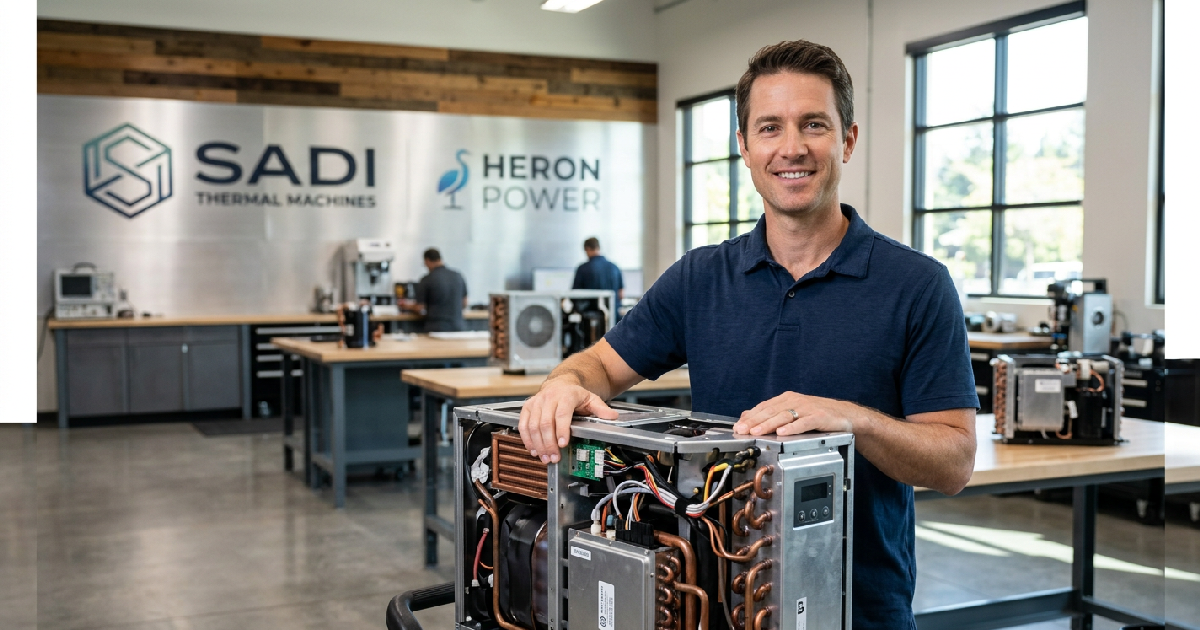
Former Tesla executive Drew Baglino has established a new heat pump venture, Sadi Thermal Machines, marking another industrial startup following his departure from the electric vehicle manufacturer. Documents filed in Delaware and California indicate the company was recently incorporated and shares a headquarters in Scotts Valley, California, with Heron Power, the transformer startup also launched by Baglino.
The new entity, reportedly first identified through business filings, appears to draw on Baglino’s background in thermal management systems. During his long tenure at Tesla, Drew Baglino oversaw the development of core energy technologies, ranging from earlier vehicle models to stationary storage systems. This move into the residential and commercial heating sector follows years of internal discussion at the automaker regarding the potential for high-efficiency heat pumps to replace traditional boilers and HVAC units.
The name Sadi Thermal Machines refers to Nicolas Léonard Sadi Carnot, the French physicist regarded as the father of thermodynamics. This scientific foundation is central to the technology Baglino helped develop in the automotive world, where precision temperature control impacts vehicle efficiency and charging speeds. Much like how infrastructure reliability is critical for digital services, physical energy infrastructure must evolve to handle the increased loads of an all-electric society.
Applying automotive thermodynamics to building climate control
Baglino was instrumental in the design of complex thermal management systems that allow vehicles to harvest waste heat from motors and battery packs to warm cabins or precondition batteries. By integrating these components into compact packages, the automotive industry has set new benchmarks for efficiency that traditional heating companies are now forced to consider.
Reports suggest that developing heat pumps for homes may actually be less technically restrictive than for cars, given that stationary units are not subject to the same severe constraints on mass and volume as those fitted into a vehicle chassis. While there has been speculation that major EV players would eventually enter the residential HVAC market, dedicated startups are now moving to fill that space.
By launching Sadi Thermal Machines, Baglino is positioning himself to address this hardware gap. The startup has reportedly recruited several former Tesla engineers, suggesting that the same design philosophy used for mobile thermal loops could soon be applied to domestic water heating. This trend of engineers moving into specialised industrial roles underscores a broader shift of technical talent toward climate-critical hardware.
The Scotts Valley industrial cluster
Sadi Thermal Machines sits alongside Baglino’s other venture, Heron Power, which focuses on power electronics. The co-location of these two startups in Scotts Valley suggests a strategic focus on the broader electrification of the grid and the home. While Heron Power addresses the efficiency of power distribution, Sadi targets the energy consumed by heating and cooling units.
This dual-track approach reflects the growing demand for industrial connectivity and smart energy management. For homeowners and commercial operators, the integration of high-efficiency heat pumps with stable localised power electronics could reduce operational costs and carbon footprints.
Strategic implications for the HVAC market
The entry of a senior automotive engineer into the heat pump sector comes at a time of increased regulatory pressure to phase out gas-fired boilers. Governments are increasingly incentivising the adoption of heat pumps, yet the industry has often faced criticism for slow innovation and complex installation requirements. If Sadi Thermal Machines can replicate the modular nature of automotive thermal systems, it may challenge established HVAC manufacturers.
Previous industrial work on coolant valves and sophisticated thermal loops provides a blueprint for a new generation of domestic machines. These systems could potentially manage cabin air, domestic hot water, and even integrate with home battery systems more effectively than current off-the-shelf solutions.
Neither Baglino nor his representatives have commented on specific product timelines or funding rounds for Sadi Thermal Machines. However, the presence of experienced engineering veterans and the clear naming convention suggest the company is moving past the conceptual stage. For an industry that has remained relatively stagnant for decades, a hardware-first approach from an automotive perspective signals a period of technical iteration ahead.
