


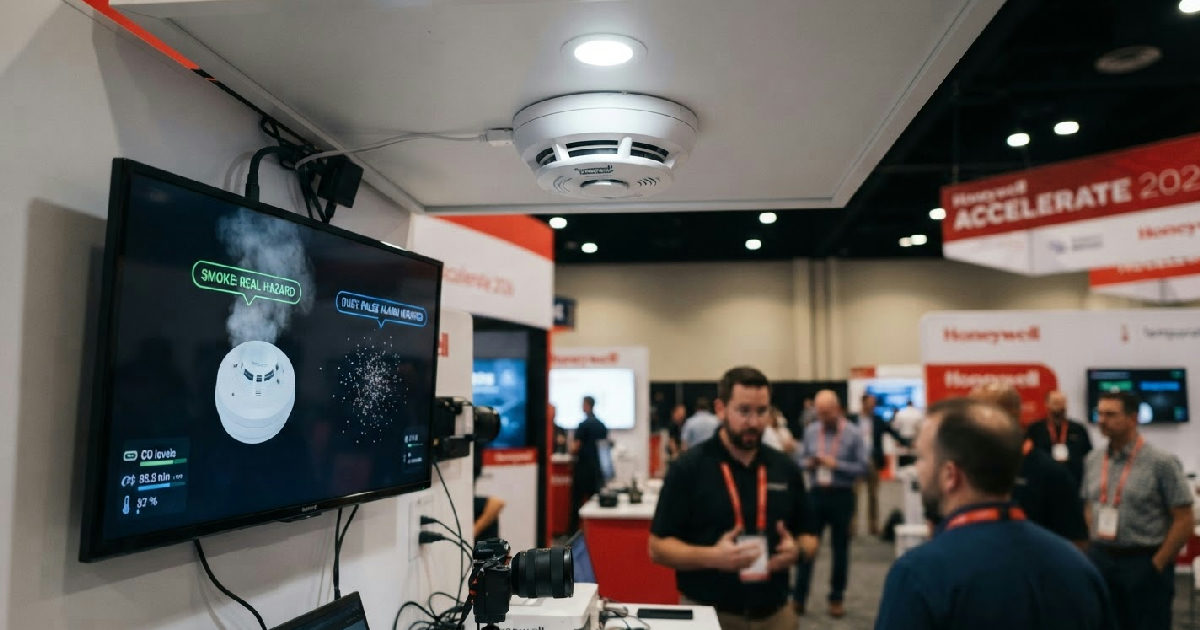
Honeywell has launched a new portfolio of intelligent fire and life safety solutions that use artificial intelligence to reduce nuisance alarms and accelerate emergency response. The new systems were unveiled on 10 November at the company’s Accelerate 2026 event in Orlando, Florida, before an audience of more than 2,000 customers and partners.
The suite includes an AI-enabled detector that can distinguish smoke from common industrial particulates, such as steam and dust; a proactive carbon monoxide monitoring system; and new command software for first responders. These tools are designed to help operators manage complex facilities with limited skilled personnel by providing earlier, more accurate warnings of developing hazards.
AI-Powered Fire Detection for Industrial Environments
According to Juan Picon, President and CEO of Honeywell’s Building Automation business, the industry has reached a critical point. “Customers today need more than connected systems and volumes of data,” he said. “They need technologies that turn information into actionable intelligence, simplify operations and enable better decisions.” The new portfolio represents a significant step towards a smarter factory automation and autonomous building operations.
For any manufacturing plant or industrial facility, nuisance alarms from conventional smoke detectors are a persistent operational headache. Airborne particles from steam, dust and manufacturing processes can trigger false alarms, leading to costly downtime, unnecessary evacuations and a general desensitisation to alarms.
To address this issue, Honeywell introduced its System Sensor Distinguish detector technology. The system combines advanced sensing hardware with AI-driven classification to analyse airborne particles. It’s trained to recognise the specific signature of an actual fire and differentiate it from non-threatening environmental conditions.
This allows facilities to maintain highly sensitive early smoke detection without the constant disruption of false alarms. It helps address the trade-off between maintaining safety and ensuring operational continuity. Instead of switching to heat or flame detectors, which may provide less early warning of a developing fire under certain conditions, operators can deploy a system designed to distinguish genuine fire signatures from environmental interference.
The technology is aimed at challenging settings, such as factories, processing plants and data centres, where airborne particulates are common. By distinguishing genuine threats from benign events, the system helps ensure that alarms indicate situations requiring prompt attention.
Proactive CO Monitoring Extends Beyond Conventional Alarms
Alongside its advanced fire detection technology, Honeywell launched new carbon monoxide (CO) monitoring capabilities that shift the approach from reactive alerting to proactive management. Traditional CO detectors typically trigger an alarm when carbon monoxide concentrations reach a predefined threshold.
Honeywell’s new system expands these monitoring capabilities. It provides facility teams with real-time CO concentration data, enabling them to monitor both sudden increases and historical trends in CO levels. The cloud-connected system can monitor CO concentrations below conventional alarm thresholds.
By tracking low CO concentrations over time, facility managers can identify potential problems with combustion equipment, ventilation systems and other building infrastructure before they develop into serious hazards. This continuous stream of data provides insights that can support preventive action, helping to reduce the risks associated with prolonged, low-level CO exposure and improve workplace safety.
Advances in AI engineering are central to the development of smarter, safer industrial facilities.
A Unified Command Centre for Emergency Response
Information overload can be a major challenge for fire crews responding to incidents in large, complex buildings. To address this challenge, Honeywell unveiled its new Incident Command software application, developed in collaboration with fire departments to streamline decision-making during emergencies.
The software provides fire-service leaders with a unified operational view. It consolidates critical information, including incident details, the locations and status of response units, operational procedures and, importantly, real-time data on the building’s condition. This enables building owners to share information continuously with first responders throughout an emergency, from initial dispatch to post-incident reporting.
This shared, real-time situational awareness enables responders to assess incidents more quickly and make better-informed decisions. Responders can arrive at the scene with prior knowledge of the alarm location, the status of the fire-suppression systems and other critical details, potentially helping them save lives and protect property more effectively. It helps bridge the communication gap between a building’s internal systems and external emergency services.
The AI platform driving Honeywell’s autonomous vision
These new safety solutions are powered by the Honeywell Forge Cognition Platform, an agentic AI and simulation platform that underpins the company’s efforts to advance autonomous building operations. Developed in collaboration with technology partners, including NVIDIA and Dell Technologies, the platform combines real-time digital twins with advanced AI to help operators understand facility conditions and anticipate potential problems.
This underlying platform enables the new safety systems to move beyond simple trigger-based alerts. It processes data from across a building’s systems to generate context-aware insights.
The collaboration with NVIDIA is central to this effort, drawing on the company’s expertise in AI computing to support the platform’s capabilities, including complex applications such as AI-powered machine vision. Honeywell has reported performance results that demonstrate the Forge platform’s potential.
Following a deployment at NVIDIA’s Santa Clara headquarters, Honeywell reported a 90% reduction in unnecessary alerts. Honeywell also identified the potential to reduce energy and utility consumption by up to 10%, highlighting the platform’s potential benefits for both safety and operational efficiency.
Building on a foundation of connected safety systems
The announcements at Accelerate 2026 mark the latest stage in the evolution of Honeywell’s safety portfolio. The company has continued to expand its cloud-based Connected Life Safety Services (CLSS) platform, which provides real-time visibility into fire safety systems and supports more streamlined system management. Features such as Zone Sync and the CLSS Rescue Assist application have already laid the groundwork for a more integrated emergency response.
The new developments also build on previous hardware innovations. The NOTIFIER INSPIRE platform, for example, incorporates smoke control and automated testing capabilities. In December 2024, Honeywell launched NOTIFIER INSPIRE with Self-Test detectors, which the company described as the first UL-approved detectors capable of performing self-tests automatically.
The VESDA Air solution, launched in 2022, was an early example of this approach, combining early-warning smoke detection with indoor air quality monitoring for pollutants such as carbon dioxide (CO₂) and volatile organic compounds (VOCs).
Looking ahead, the company is reportedly preparing to unveil Niagara 5, the next generation of its Niagara framework, in early 2027. The framework provides the underlying connectivity needed to integrate disparate building systems, including heating, ventilation and air conditioning (HVAC), security and lighting systems from different vendors. When combined with the capabilities of the Forge platform, the framework could provide operators with a more comprehensive, context-aware view of their building portfolios.
Together, these innovations reflect a clear strategic direction: shifting from isolated, reactive systems towards a more cohesive, intelligent and increasingly autonomous ecosystem. For the engineers and operators responsible for managing industrial facilities, this shift could deliver improved safety, greater operational resilience and increased efficiency.
