


The United States Commerce Department has approved the sale of advanced Nvidia artificial intelligence chips to Chinese companies with demonstrable ties to blacklisted firms and the Chinese military. An investigation by The New York Times, published on November 7, 2026, uncovered a pattern of approvals that challenges the effectiveness of US export controls designed to protect national security.
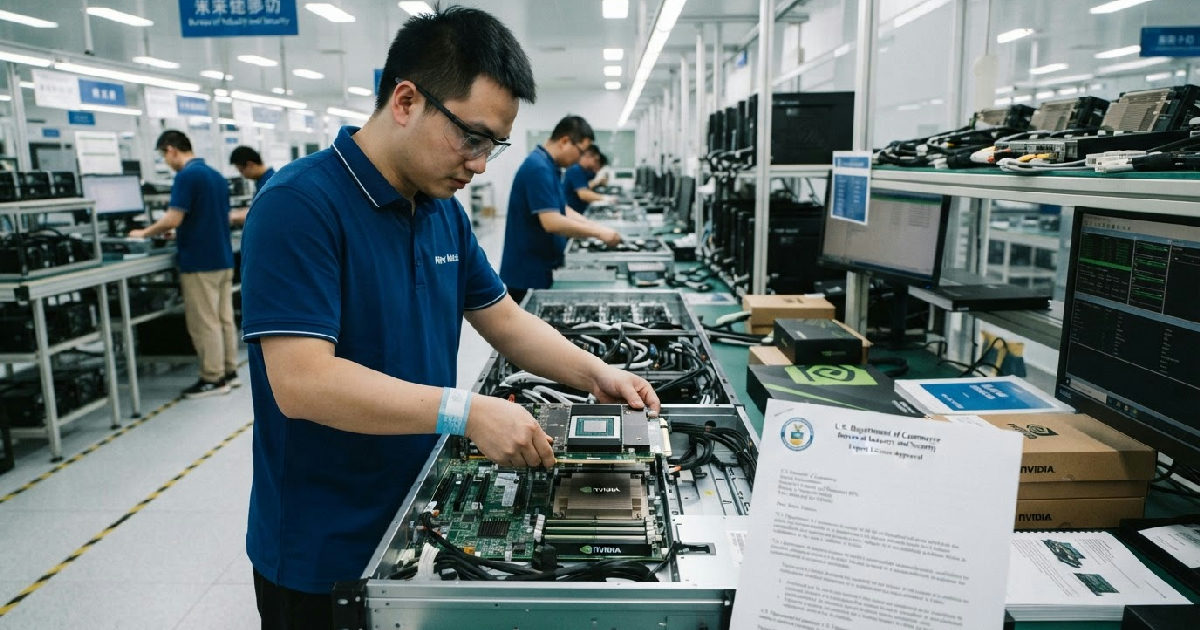
Among the approved firms is New Matrix, a Beijing-based company whose registered address was found to be a vacant office shell. The company was authorised to assemble Nvidia’s powerful H200 AI chips into servers, despite its owners’ connections to a private equity firm the US government placed on its Entity List in 2024.
Commerce Department investigation uncovers troubling connections
The findings raise urgent questions about the due diligence performed by both Washington and the American tech giant.
The report from The New York Times paints a concerning picture of the entities gaining access to strategically sensitive American technology. Reporters visiting the listed address for New Matrix, located in a new industrial park on the northwest edge of Beijing, discovered a “hollow gray shell with wires dangling from the ceiling”.
Property management had no record of the company, which was established just 17 months ago, and it did not appear in the building’s directory.
Digging deeper, the investigation revealed that New Matrix is owned by Wise Road, a Chinese private equity firm sanctioned by the US Commerce Department in 2024. Wise Road was blacklisted for its alleged role in helping Beijing acquire semiconductor companies and technology deemed critical to national security.
Analysts cited in the report believe New Matrix may serve as a front for other Wise Road-linked companies to procure technology.
This was not an isolated incident. Another approved company, Maginfra, was also found to have a deserted registered office when visited by reporters. Analysts believe Maginfra is connected to Inspur, a major Chinese technology company placed on the US Entity List for its direct involvement with China’s military. The links were established through shared personnel, patents, and partial government ownership, according to the report.
More red flags in the approved list
The network of questionable buyers extends further. The investigation highlighted several other firms among the roughly two dozen approved to purchase or handle up to 75,000 H200 chips each. This includes Zhejiang Yindun Cloud Technology, which is connected to a group providing cloud services for a satellite program run by a provincial defence bureau in Hebei.
Another firm, Shanghai Jiatang, grew out of the state-owned Datang Telecom. That entity is controlled by the China Academy of Telecommunications Technology, a key developer of cryptography for the Chinese military. These approvals suggest that the screening process may not be adequately identifying end-users with clear links to China’s military-industrial complex.
A flawed process and a major policy shift
The approvals stem from a significant policy change. The Trump administration authorised sales of the H200 chip to China in December 2025, relaxing a previous ban. The arrangement stipulated that chips made in places like Taiwan must first pass through US territory, allowing the US to collect a 25% tariff on their value.
In January 2026, rules were issued requiring Chinese buyers to demonstrate adequate security and confirm non-military use.
However, the vetting process appears to rely heavily on paperwork and remote verification rather than physical, on-site inspections. This loophole potentially allows shell companies or front organisations to pass muster without deeper scrutiny.
Liza Tobin, a former China director on the White House National Security Council, voiced significant concerns. She stated, “I have a ton of concerns that neither the Commerce Department nor Nvidia is doing the due diligence needed to ensure that the licensing terms are being followed.”
The ease with which these firms secured approval calls into question the rigour of the entire export control regime. Despite the Commerce Department hiring over 90 new enforcement officers and levying $324 million in penalties for violations in 2025, this investigation suggests significant gaps remain in its oversight.
The high-stakes world of AI chip exports
While this case involves Nvidia’s H200 chips, the implications are much broader, touching on the global race for AI supremacy. These advanced semiconductors are the engine of modern artificial intelligence, capable of training the large language models and powering the complex algorithms that are reshaping industries.
Their dual-use nature makes them a point of intense geopolitical friction; the same chip that optimises a consumer supply chain can also be used to develop advanced weaponry or run mass surveillance systems.
Nvidia has maintained that its interests are not aligned with arming a strategic rival.
Spokesman John Rizzo stated that “it makes no sense for the Chinese military to depend on American technology.” Indeed, shipments of H200 chips to customers in China accounted for less than 1% of Nvidia’s data centre revenue in the quarter ending in July. Yet the risk lies not in volume, but in capability.
Even a small number of these powerful chips could provide a significant boost to a specific military or surveillance programme.
The list of approved buyers also includes major, legitimate commercial players like Baidu, Alibaba, Tencent, BYD, and Tesla’s Shanghai unit. This highlights the difficult balancing act for US policymakers.
The aim is to restrict military access without cutting off a vast and lucrative commercial market that many American companies depend on. The challenge remains discerning a legitimate buyer from a front for a sanctioned entity, especially within a complex approval system.
Implications for industrial technology and what comes next
For professionals in manufacturing and engineering, this story underscores the deeply intertwined nature of technology, commerce, and geopolitics. The AI chips at the centre of this controversy are fundamental to the next generation of industrial technology.
They power machine vision systems, predictive maintenance algorithms, and autonomous robotics that define Industry 4.0. This impacts areas from factory floor automation to complex supply chain optimisation, shaping the competitive landscape for decades.
The fallout from this investigation will likely be significant. It could trigger congressional hearings and force a comprehensive review of the Commerce Department’s licensing and enforcement procedures. The reliance on paper-based verification for strategically critical technology now appears dangerously inadequate.
The incident may strengthen the hand of those in Washington advocating for a much stricter, more comprehensive ban on high-end tech exports to China, regardless of the commercial cost. Such a move would have unforeseen impacts on manufacturing supply chains globally.
While The New York Times did not find direct evidence that H200 chips had been diverted to military programmes, the potential for it is now laid bare. The existence of approved shell companies with ties to sanctioned entities is a critical failure of the export control system.
Moving forward, both the US government and the companies profiting from this trade will face immense pressure to prove they can effectively track and verify the end-use of their most powerful technologies. The alternative is to risk enabling the very capabilities their policies are designed to prevent.
