


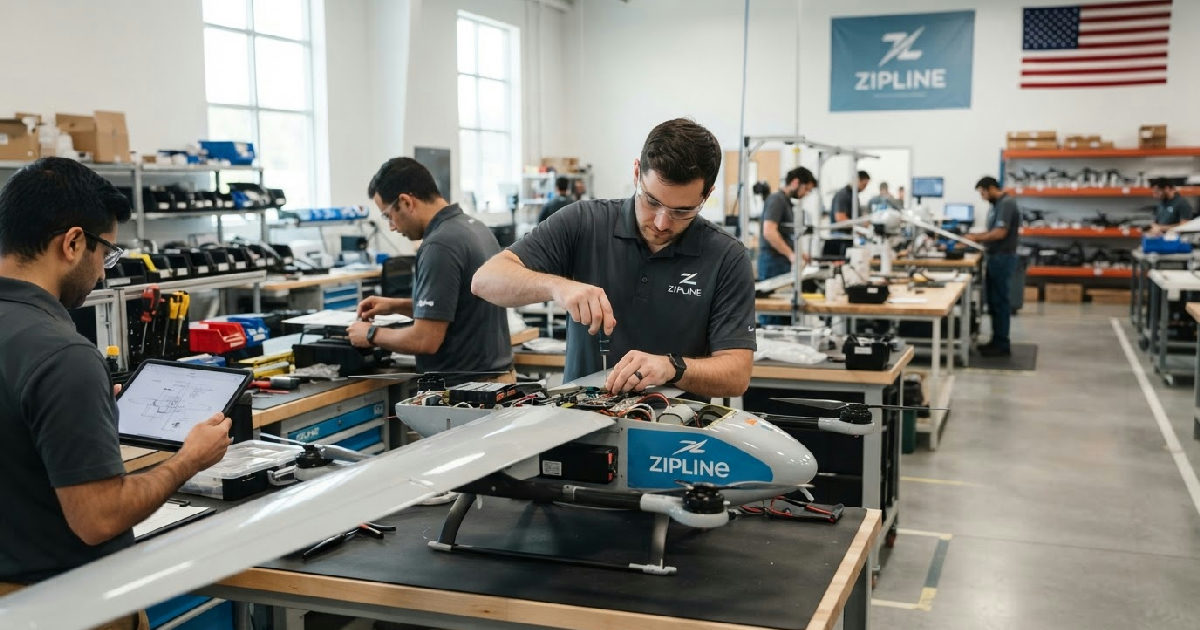
Autonomous drone delivery company Zipline has raised $1.5 billion in a new funding round to expand its US manufacturing facilities, increase hiring and build a nationwide drone delivery network.
The November funding round was led by Paradigm, WCM Investment Management and Layer Global, with participation from investors including Fidelity Management & Research Company, Uber, Tiger Global, J.P. Morgan, ARK Invest and Salesforce Ventures. The round values Zipline at $21.5 billion after the investment.
Boosting US drone manufacturing
Zipline is now pursuing a broader expansion of its US drone delivery network, supported by its latest funding round.
Expanding domestic manufacturing is a central part of Zipline’s growth strategy. The company manufactures its autonomous aircraft in South San Francisco, California, and plans to use the new funding to expand its US production facilities.
By keeping manufacturing in-house and in the US, Zipline maintains tight control over quality and innovation cycles.
Zipline’s approach places emphasis on reliability and product quality. “Our job is to make sure that we are building the most reliable and highest-quality system in the world,” said co-founder and CEO Keller Rinaudo Cliffton.
The ability to rapidly iterate on hardware and software is critical as the company rolls out new platforms and enters more complex operational environments. The focus on domestic production also helps navigate supply chain vulnerabilities and intellectual property risks.
Scaling production will require Zipline to refine its manufacturing processes alongside increasing output. Its approach draws on high-volume manufacturing principles to support the production of autonomous aircraft at commercial scale.
The P2 Zip delivery platform
Zipline’s Platform 2 (P2), unveiled in March 2023, is designed for direct-to-home deliveries in urban and suburban areas. Its design combines an autonomous aircraft with a tethered delivery device that lowers packages to designated drop-off locations.
Unlike Zipline’s earlier long-range delivery platform, P2 is designed for quieter residential deliveries. Its aircraft can fly more than 300 feet above the ground while a tethered delivery device, known as a Zip, lowers the package to a designated location without requiring the aircraft to land.
The P2 platform supports Zipline’s expansion into retail and food delivery. The company announced partnerships involving Walmart and Sweetgreen, among other organisations, when it introduced the system. Its design is intended to support quiet, precise deliveries to homes and other designated locations. It showcases a sophisticated approach to solving the final, most expensive leg of the delivery journey.
Zipline lists a 10-mile service radius for P2, with the aircraft designed to carry payloads of up to 8 lb. Any claim about daily deliveries per station should be supported by a source specifying the operating conditions and authorised capacity.
From Rwandan blood drops to American groceries
Zipline began operations in Rwanda in 2016, delivering blood and other medical supplies to healthcare facilities. It has since expanded into additional markets and applications, including retail, food and healthcare deliveries in the United States. The company’s latest announcements describe a delivery network operating across four continents.
The expansion illustrates how Zipline has moved from medical logistics into consumer and commercial delivery. Its experience in healthcare provides an established operational foundation, while retail and food delivery offer additional markets for its autonomous aircraft.
Zipline has also developed healthcare delivery partnerships in the United States, including with MultiCare Health System and Intermountain Health.
This journey from specialised medical delivery to broad commercial use shows how autonomous systems can mature. The challenges of navigating complex airspace and ensuring reliability are immense, and Zipline’s success provides a blueprint for others in the field of scaling autonomous equipment for commercial applications. The company has effectively created a new model for instant logistics.
The strategic partnerships fuelling growth
Zipline’s latest $1.5 billion funding round is intended to support manufacturing expansion, hiring and the development of a nationwide delivery network. Its commercial partnerships are also central to that expansion. On 5 November 2026, Walmart announced a new multi-year agreement with Zipline to add 300 drone delivery sites across the United States, with potential for further expansion.
The deal aims to bring drone delivery to thousands of new households, leveraging Walmart’s vast network of stores as local fulfilment centres.
In August 2026, Uber and Zipline announced a partnership to bring drone deliveries to Uber Eats customers. The companies aim to reach one million drone deliveries per day by the end of 2029, with initial deployments planned in existing Zipline markets and expansion into additional US cities. Uber also agreed to make a strategic investment in Zipline, although the amount was not disclosed.
The partnerships combine Zipline’s aircraft and delivery operations with established retail and ordering networks. For Walmart and Uber, the arrangement offers another delivery option for eligible customers, although the long-term cost and operational benefits will depend on how the services scale.
Walmart has said the expanded partnership will use its existing store network to extend drone delivery to more customers. In its 5 November announcement, the retailer said the agreement would add 300 sites nationwide.
Outlook: Navigating the path to mainstream adoption
Despite its established technology and commercial partnerships, Zipline faces regulatory and public-acceptance challenges as it expands its US operations.
Expanding autonomous drone deliveries in the United States requires compliance with Federal Aviation Administration (FAA) regulations governing commercial drone operations. The regulatory framework, including the requirements for flights beyond the operator’s visual line of sight, will influence how quickly Zipline can expand its network. Public acceptance will also matter as drone deliveries become more common, particularly in relation to noise, privacy and operational safety.
Zipline says P2 is designed to reduce the noise associated with residential deliveries by keeping the aircraft high above the ground while lowering packages on a tether. The extent to which this design addresses community concerns will depend on operational performance and public experience. The fresh capital provides a long runway to overcome these hurdles and solidify its position as a leader in the automated logistics sector.
Expanding its manufacturing workforce will be important as Zipline increases production and extends its delivery network.
The availability of skilled manufacturing workers could influence how quickly Zipline expands production. However, the company’s ability to scale will also depend on facility capacity, supply-chain reliability, regulatory approvals and demand for its delivery services.
Zipline’s latest funding round marks a further step in its plans to expand US drone manufacturing and build a nationwide autonomous delivery network.
