


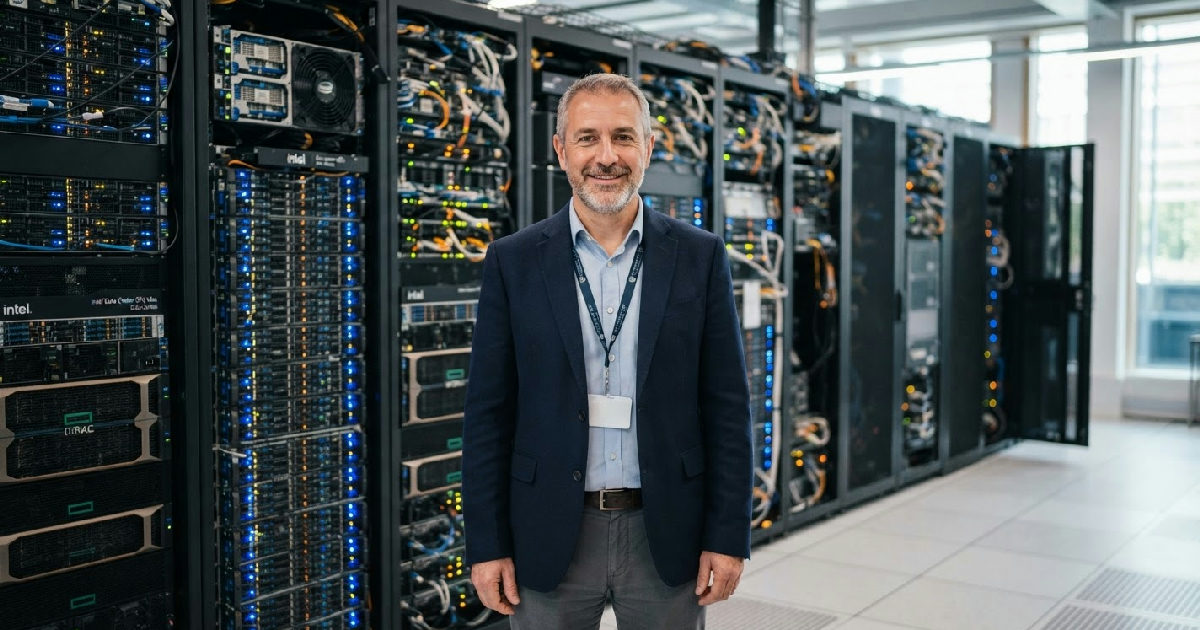
Dr. Paul Calleja leads the Dawn supercomputer, significantly boosting Europe’s AI power. Paul Calleja leads the Dawn supercomputer, boosting Europe’s AI power.
The Dawn supercomputer, housed within the University of Cambridge, represents a significant leap in the UK’s scientific research capabilities. It aims to unlock new frontiers in fields ranging from materials science and nuclear fusion to drug discovery, areas where immense computational power is essential for breakthroughs.
Paul Calleja engineers Europe’s AI supercomputing powerhouse
This initiative underscores a broader European drive to establish robust AI infrastructure, reducing reliance on external providers and fostering indigenous technological advancement.
The Dawn supercomputer is a testament to collaborative engineering and strategic investment. Developed through a partnership between the University of Cambridge, UK Research and Innovation (UKRI), and Hewlett Packard Enterprise (HPE), the system is a formidable piece of hardware. It integrates cutting-edge components to achieve its staggering performance metrics, marking a new era for scientific computation in the region.
At its core, Dawn is powered by Intel Xeon CPUs, complemented by 2,560 Intel Data Center GPU Max Series accelerators, specifically the Ponte Vecchio generation. This combination is engineered to handle the most demanding AI workloads and complex scientific simulations. The system also boasts an impressive 100 petabytes of storage, ensuring ample capacity for the vast datasets generated and processed by its high-performance operations.
Dawn’s Technical Specifications and Capabilities
The sheer scale of Dawn’s capabilities is designed to push the boundaries of what’s currently possible in research. Its 10 ExaFLOPS of AI performance translates into the ability to execute ten quintillion floating-point operations per second, a speed critical for training large AI models and running intricate simulations. This makes it one of the most powerful AI supercomputers across Europe.
Researchers will leverage Dawn for a diverse array of applications. In materials science, it can simulate atomic interactions to design new compounds with specific properties. For nuclear fusion, it will model plasma behaviour, bringing the promise of clean energy closer.
In drug discovery, Dawn can accelerate the identification of new therapeutic molecules by simulating their interactions with biological targets, potentially shortening development timelines significantly. Such advanced computational tools are becoming increasingly vital for factory automation and industrial innovation.
A Career Forged in High-Performance Computing
Dr. Paul Calleja’s journey to leading such a monumental project began unusually early. He started programming at the tender age of six, famously sneaking onto his mother’s typewriter to experiment. “I used to sneak onto my mum’s typewriter at age six and try to program it,” he recalled, highlighting an early, self-taught passion that would define his career trajectory.
With over 30 years of experience in high-performance computing (HPC), Dr. Calleja has a distinguished track record. Before joining the University of Cambridge in 2012, he played a crucial role at the Wellcome Trust Sanger Institute.
There, he was instrumental in building one of Europe’s largest computing facilities dedicated to genomics, a foundational experience that honed his expertise in managing vast computational resources for scientific discovery.
His long-standing commitment to advancing computational science underscores the human element behind these technological marvels. It’s a career built on continuous learning and adaptation, from the rudimentary mechanics of an early typewriter to the complex architectures of modern supercomputers. This dedication is now directly contributing to the UK’s strategic advantage in AI research and development.
The UK’s Broader AI Infrastructure Ambitions
The Dawn supercomputer is not an isolated endeavour but a cornerstone of the UK government’s broader investment in AI infrastructure. It forms a critical part of the DiRAC (Distributed Research utilising Advanced Computing) facility, which serves as the UK’s integrated national e-infrastructure for theoretical astronomy and particle physics. This strategic placement ensures that Dawn’s capabilities are integrated into a wider network of national research assets.
The UK’s commitment to AI is evident in its sustained investment in such facilities. By providing researchers with access to world-class computing power, the nation aims to attract top talent, foster innovation, and maintain its competitive edge in scientific and technological advancement. This investment is crucial for supporting both academic research and industrial applications, driving economic growth and solving complex societal challenges.
European Drive for AI Autonomy
Beyond the UK, Europe as a whole is making significant strides in bolstering its AI supercomputing capabilities. The European Union has allocated €7 billion for the period 2021-2027 to establish a comprehensive supercomputer network. This ambitious plan aims to close the computational gap with global leaders like the United States and China, fostering greater technological sovereignty.
Initiatives like the EuroHPC Joint Undertaking (JU) manage a growing network of supercomputers and “AI Factories,” providing subsidised high-performance compute resources to a broad user base. Notable European systems include JUPITER at Forschungszentrum Jülich, which is set to be the first European exascale supercomputer, along with MareNostrum 5 in Spain and LUMI in Finland.
These collective efforts highlight a concerted push to develop robust, independent AI infrastructure across the continent, reducing reliance on non-European cloud providers for training advanced AI models. This strategic focus is also reflected in the UK manufacturing PMI growth, which indicates broader economic shifts.
Global Implications and African Parallels
The development of supercomputers like Dawn underscores a global race for AI compute power, a critical determinant of future economic and scientific leadership. Nations worldwide are investing heavily in these advanced systems, recognising their pivotal role in everything from national security to economic competitiveness. The ability to process vast amounts of data and train sophisticated AI models is now a fundamental pillar of national strategy.
This global trend has significant implications for emerging economies, particularly in Africa. While Europe and North America lead in current supercomputing capacity, African nations are increasingly recognising the need to develop their own AI infrastructure. Nigeria, for instance, launched a hyperscale-ready AI data centre in Lagos in October 2026, equipped with advanced GPU clusters.
This initiative aims to address the computational capacity gap on the continent and enhance data sovereignty.
Furthermore, Nigeria’s launch of the Nigeria AI Scaling Hub (NAISH) and a national shared compute infrastructure in June 2026, supported by the Gates Foundation, signals a concerted effort to expand access to AI resources.
These developments, alongside initiatives from the Federal Ministry of Communications, Innovation & Digital Economy, aim to foster AI systems tailored to local languages, markets, and economic challenges. Such efforts are crucial for Africa to harness the transformative potential of AI, ensuring it is a participant, not just a consumer, in the global AI revolution.
The strategic investments in infrastructure, much like the Dawn supercomputer, are foundational to future industrial and technological progress.
The Future of AI Research and Industrial Application
The capabilities offered by supercomputers like Dawn extend far beyond pure academic research; they hold immense potential for industrial applications. Industries such as automotive, aerospace, pharmaceuticals, and energy are increasingly relying on advanced simulations and AI models to accelerate product development, optimise processes, and predict outcomes. For instance, complex engineering designs can be tested virtually, reducing the need for expensive physical prototypes and shortening time-to-market.
The ability to rapidly process and analyse massive datasets also fuels advancements in predictive maintenance, supply chain optimisation, and quality control within manufacturing. This integration of high-performance computing into industrial workflows is transforming operational efficiencies and fostering new avenues for innovation.
As AI models become more sophisticated, their demand for computational power will only intensify, making investments in infrastructure like Dawn critical for maintaining a competitive edge in global markets.
Bridging Academic Breakthroughs and Commercial Impact
One of the key objectives behind projects like the Dawn supercomputer is to create a bridge between cutting-edge academic research and tangible commercial impact. By providing researchers with unparalleled computational tools, the potential for groundbreaking discoveries increases exponentially. These discoveries, whether new materials, more efficient energy solutions, or novel drug therapies, can then be translated into real-world applications and products.
The collaboration between academic institutions, government funding bodies, and private enterprises, as seen with the University of Cambridge, UKRI, and HPE, is essential for this translation. It ensures that the infrastructure built is not only scientifically robust but also aligned with the needs of industry.
This synergy is vital for fostering an ecosystem where scientific advancements can rapidly contribute to economic growth and societal benefit, reinforcing the UK’s position as a leader in both research and industrial innovation.
