


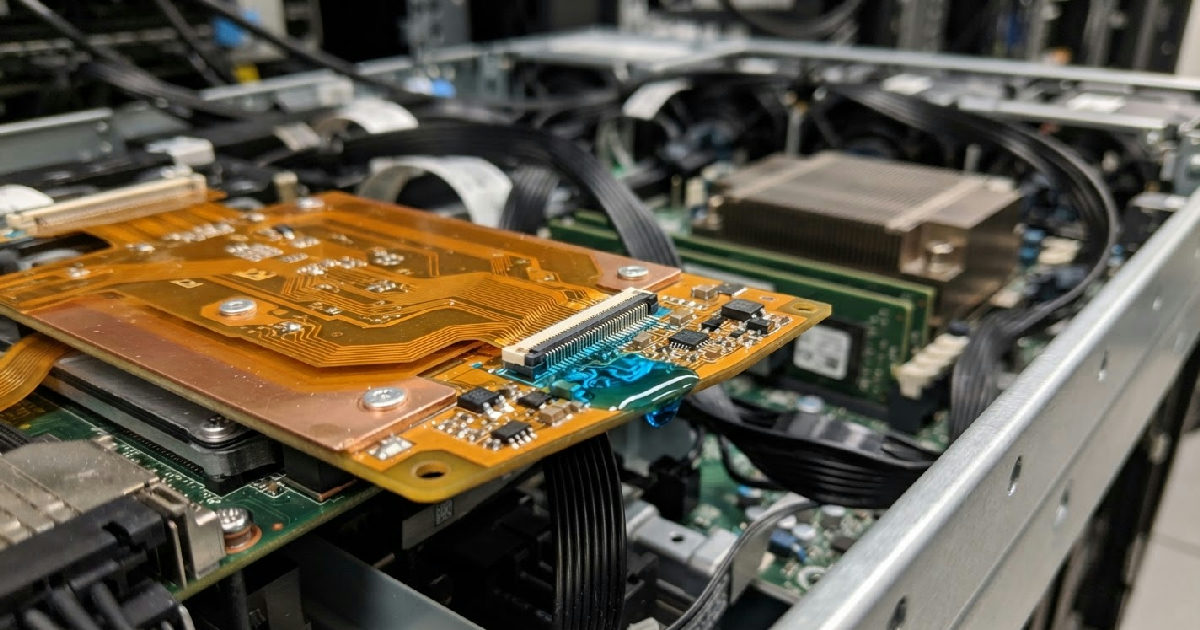
Flexible Circuit Technologies Inc. is introducing a new liquid leak-detection assembly designed for flexible circuit boards.
As AI and HPC platforms rapidly adopt direct-to-chip liquid cooling, the risk and consequences of coolant leaks are increasing. The Minnesota-based company’s flexible assembly is designed to detect leaks early at potential failure points in complex cooling architectures.
FCT’s Leak Detection System for High-Density Computing
The shift towards liquid cooling in advanced computing is being driven by the increasing heat loads generated by AI processors and high-performance computing systems. While highly effective at thermal management, liquid cooling introduces a new vulnerability: the potential for leaks. Even small coolant leaks can damage electronic components and result in equipment downtime and associated costs.
FCT’s Liquid Leak Detection Flex Assembly directly addresses this by providing a localised monitoring capability. Its design allows it to conform closely to the intricate geometries of cooling systems, allowing sensors to be positioned near potential leak points while maintaining a thin profile that suits space-constrained server racks and enclosures.
Engineered for Custom Integration and Precision
A key feature of FCT’s new assembly is its flexibility and customisation. Manufacturers can configure the system with specific sensing patterns, circuit geometries, connector interfaces, and multiple detection zones. This adaptability allows the assembly to be used across different computing applications, from individual server components to full coolant distribution units.
Potential monitoring locations include supply and return quick disconnects, GPU and CPU cold plates, manifolds and coolant lines, GPU and CPU cold plates, manifolds, and the coolant lines themselves, extending into CDUs and server trays. The inherent flexibility means it can be integrated directly into equipment by original equipment manufacturers (OEMs) and cooling-system producers.
This moves beyond traditional facility-level monitoring, enabling real-time, pinpoint detection directly at the source of a potential issue, much like how simulation software integrates with design platforms.
Tailored Design for Specific Architectures
FCT plans to collaborate closely with server OEMs, original design manufacturers (ODMs), liquid-cooling firms, cold-plate manufacturers, thermal-management suppliers, and data-centre infrastructure providers. This approach allows the assembly to be adapted to different cooling architectures and equipment requirements.
Ray Cottrell, EVP of Flexible Circuit Technologies, emphasised this bespoke approach. He noted, “The rapid growth of liquid-cooled AI infrastructure is creating a new need for thin, compact, highly customized leak-detection solutions.” The comments highlight the company’s focus on customised leak-detection applications.
Cottrell further clarified FCT’s strategic position, stating: “FCT’s strength is designing flexible circuits around the customer’s mechanical and electrical requirements. This concept allows us to bring that capability directly to cold plates, manifolds, quick disconnects, and server-level cooling assemblies where early detection can help protect high-value electronics.”
The Cost Implications of Liquid Leaks
In high-value computing environments, the cost of a liquid leak extends far beyond the immediate damage to a single component. Data centres require high availability, while unexpected equipment failures can result in high operational costs. A leak can trigger cascading failures, data loss, and prolonged service outages.
Such disruptions can result in lost revenue, equipment damage, and reputational costs, making early detection relevant to both equipment protection and operational continuity.
The ability to identify and address a leak rapidly can limit the affected area, minimise equipment replacement costs, and drastically reduce downtime. This preventative capability can help reduce downtime and support operational continuity, a critical factor for businesses reliant on continuous data processing and AI capabilities.
Investing in solutions like FCT’s assembly helps mitigate these significant operational and financial risks by safeguarding the very hardware that powers these advanced operations, addressing a key aspect of manufacturing AI adoption challenges.
Beyond Facility-Level Monitoring
Facility-level leak-detection systems can alert operators to leaks or spills within a broader area, but may provide less precise information about the location of a leak. While useful, these systems may not pinpoint the exact source quickly enough to prevent localised damage within a dense server rack. FCT’s approach integrates sensing directly into the cooling loop at the component level.
This is intended to provide more localised alerts, enabling faster intervention and more precise mitigation efforts before broader system compromise.
This granular level of detection is particularly crucial in the complex, interconnected world of modern data centres, where a leak near a cold plate could potentially affect nearby GPU or CPU hardware if not detected and addressed promptly. The flex-based design provides an additional layer of leak monitoring that complements, rather than replaces, broader environmental monitoring.
FCT’s Manufacturing and Engineering Foundation
Flexible Circuit Technologies, established in 2000, maintains its U.S. headquarters in Minneapolis, Minnesota. The company has built a reputation for its specialisation in flexible circuits, rigid-flex, flexible heaters, printed electronics, and complete product module assemblies. This manufacturing and engineering experience supports the development of its leak-detection assembly.
FCT supports its global operations with substantial manufacturing facilities in China, including a 485,000 sq. ft. complex in Zhuhai, a 170,000 sq. ft. facility in Zhangzhou, and a 60,000 sq. ft. facility in Jiangmen.
The facilities support both low-volume prototyping and higher-volume production. The company also provides engineering services covering design consultation, optimisation, design for manufacturing (DFM), supply-chain management and production support.
Quality and Scale in Production
The company’s manufacturing operations also include EMS and assembly services, featuring 15 SMT lines and dedicated clean rooms (100K and 10K classifications) critical for sensitive electronic assembly. FCT’s commitment to quality is underscored by its array of certifications, including ISO 9001:2015, ISO 14001, ISO 13485, IATF 16949, and VDA 6.3.
These certifications indicate that the company’s facilities and processes are assessed against the requirements of the relevant standards. The production capability allows the company to support both prototyping and higher-volume manufacturing requirements.
The Evolving Landscape of Data Centre Reliability
The introduction of FCT’s Liquid Leak Detection Flex Assembly reflects the growing use of specialised monitoring technologies in high-density computing systems. As AI and HPC systems continue to increase computing performance and power density, the infrastructure supporting them must evolve in parallel. The increasing adoption of direct-to-chip liquid cooling creates additional requirements for leak detection and monitoring alongside existing environmental controls.
The development illustrates how integrated sensing could become more widely used in high-performance computing and other equipment where liquid-cooling reliability is important. The focus is no longer just on raw performance but also on resilience and proactive maintenance.
For manufacturers and operators, such technologies could provide an additional tool for managing equipment and operational risks. This helps ensure digital infrastructure can reliably support industrial and economic aspirations.
FCT’s experience in flexible circuit design and manufacturing supports its ability to develop customised leak-detection assemblies for liquid-cooled environments.
