


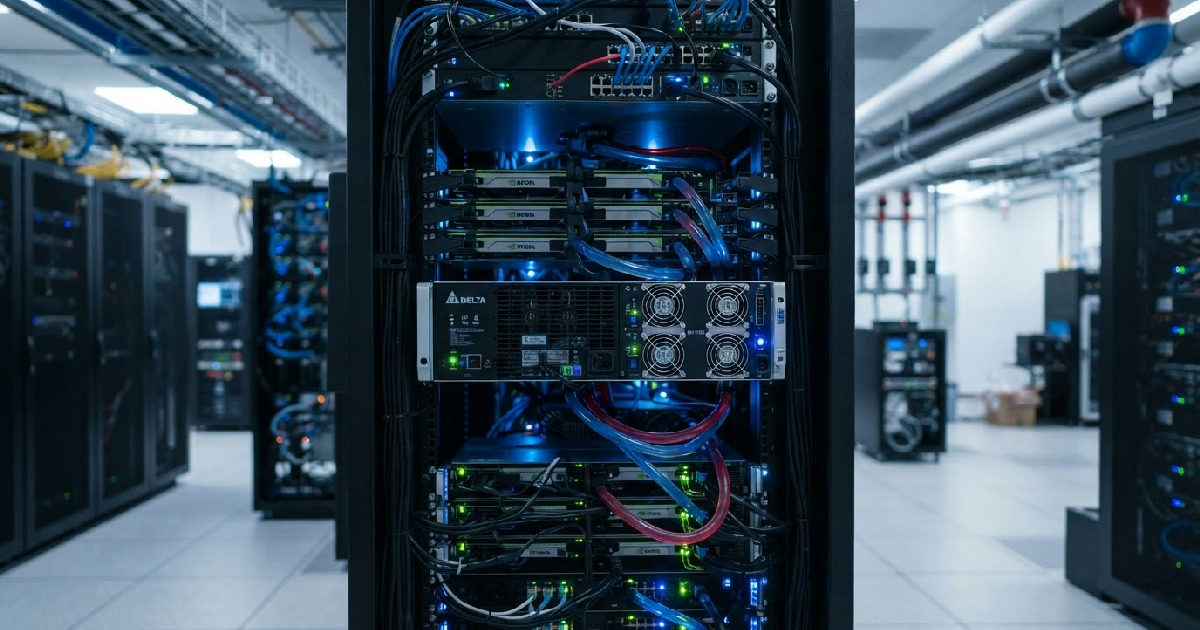
Delta Electronics has unveiled integrated power and thermal-management infrastructure designed for NVIDIA’s next-generation DSX AI factories.
These solutions are engineered to tackle the immense energy and heat challenges posed by large-scale AI model training and deployment. The collaboration between Delta and NVIDIA aims to provide an infrastructure approach for deploying large-scale AI computing facilities, known as AI factories.
Delta reveals new 800 power and heat solutions
The announcement addresses infrastructure challenges associated with expanding AI computing capacity. Compute performance has increased rapidly, while the infrastructure required to power and cool these systems has had to accommodate increasingly demanding workloads. Power availability and facility infrastructure remain significant constraints on companies seeking to expand AI computing capacity.
At the heart of Delta’s approach is the integration of facility power systems with the thermal management of IT hardware. This differs from conventional data-centre approaches in which power and cooling systems may be specified and installed separately.
Delta says that coordinating power and cooling as a single system can improve AI performance per megawatt. This unified stack includes on-site energy storage systems, solid-state transformers for managing grid intake, and medium-voltage equipment for distributing power throughout the facility.
The integrated stack extends into the data hall through row- and rack-level power distribution and liquid cooling, ultimately delivering conditioned power to the computing hardware. This integrated approach is intended to address the rapid changes in power demand associated with GPU-intensive workloads.
Vladimir Troy, Vice President of AI Infrastructure at NVIDIA, underscored this necessity. He stated that “AI factories must be designed as complete systems, with power, cooling and compute working together.” Troy added, “Delta’s expertise in 800 VDC power delivery and liquid cooling will help customers deploy AI factories based on NVIDIA DSX faster and get more AI performance from every megawatt.”
The engineering behind the 800 VDC architecture
The standout technology in Delta’s announcement is its 800 VDC power architecture. Traditional data centres distribute AC power, which undergoes several conversion stages before reaching the DC-powered components within servers.
Each conversion step results in energy loss, primarily as waste heat. This heat then must be removed by the cooling system, consuming even more power. By distributing power at a higher DC voltage, Delta’s architecture is designed to reduce the number of conversion stages.
Delta says the approach can achieve power-conversion efficiency of up to 98%. This applies from the facility entrance to the computing hardware. At board level, specialised DC-DC converters step the 800 VDC distribution voltage down to lower DC voltages, including 50 VDC or 12 VDC, for use by downstream power systems. These achieve a peak efficiency of up to 98.5%.
Fewer conversion stages can reduce energy losses and associated heat generation, while higher-voltage distribution can also reduce the amount of copper required for a given power transfer. This efficiency can help reduce energy losses and increase the computational capacity that can be supported within a given power envelope. The system is also designed for resilience. In-row systems provide up to 800 kW in a single power rack.
Integrated battery and capacitance backup technologies help stabilise the system against the rapid load changes characteristic of GPU clusters. This capability is part of the infrastructure required to support high-performance AI workloads.
Integrated liquid cooling for extreme density
Power delivery is only one part of the infrastructure challenge. The heat generated by densely packed high-performance GPUs can exceed the practical cooling capacity of conventional air-cooling systems. Delta’s solution pairs its power architecture with a comprehensive liquid cooling portfolio. This portfolio is designed to remove heat efficiently at every level of the AI factory.
Delta’s thermal-management portfolio includes 2.4 MW and 3 MW liquid-to-liquid cooling distribution units, in-rack cooling systems, and thermal solutions for AI racks. These systems are designed to coordinate cooling at the facility, row, rack, and component levels for AI infrastructure based on NVIDIA DSX.
In-rack cooling systems circulate liquid directly to cold plates mounted on high-heat-generating components such as GPUs and CPUs. This removes heat at its source.
Prefabrication as a deployment accelerator
To support the deployment of new AI capacity, Delta is using a modular construction strategy. Its prefabricated AI modular data centre solution integrates 800 VDC power systems and 3 MW of liquid-cooling capacity into self-contained, factory-built blocks. These modules are assembled and fully tested in a controlled environment before being shipped to the site.
This approach is intended to reduce the complexity and duration of on-site construction. With much of the integration work completed off-site, commissioning the data centre is streamlined. Delta says the approach can reduce deployment time by up to 60%. Operators can then add capacity in phases and bring computing capacity online sooner.
“AI factory economics begin with a simple question: how much intelligence can be produced from every available megawatt?” explained Austin Tseng, President of Delta Electronics Americas. Tseng added, “The answer depends on more than facility power alone. Delta and NVIDIA connect those layers — energy, power, cooling and components — allowing AI factory operators to reach time-to-first-token sooner and optimise token output at scale.”
Implications for industrial infrastructure
Although designed for NVIDIA’s DSX platform, some of the underlying approaches could also be relevant to other high-density computing and energy-intensive applications. The push toward high-voltage DC power distribution and integrated liquid cooling provides a potential roadmap for other energy-intensive industrial applications.
This includes high-performance computing clusters in research and engineering. Potential applications could also include advanced manufacturing facilities with energy-intensive computing or thermal-management requirements.
The NVIDIA DSX Platform synergy
Delta’s infrastructure is specifically tailored for the NVIDIA DSX AI Factory Platform. The platform brings together reference designs, software, accelerated computing systems, facility infrastructure, and partner technologies. Its aim is to streamline AI factory design, deployment, and operation.
NVIDIA positions the DSX platform as a way to reduce token costs and accelerate deployment across the full infrastructure stack. This includes DSX MaxLPS software, which is designed to maximise token performance per megawatt.
Additionally, open-source, modular DSX OS software handles lifecycle management, runtime consistency, health automation, and resiliency. It also supports multi-tenant AI factory operations and platform services. The software layer is designed to work alongside the physical infrastructure provided by partners such as Delta.
