


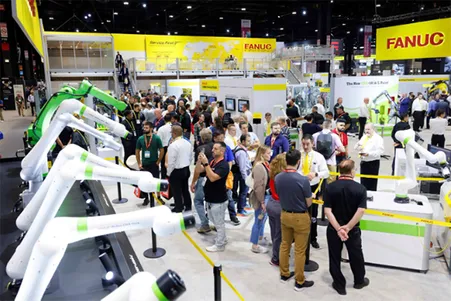
The International Manufacturing Technology Show (IMTS) is underway this week at McCormick Place in Chicago, Illinois, bringing together companies showcasing developments in industrial manufacturing. Given the scale of the event, several developments in additive manufacturing have emerged from companies showcasing new technologies and applications.
These developments reflect a move towards more integrated, automated and application-specific additive manufacturing (AM) solutions. Companies such as DN Solutions, Farsoon Technologies, Grenzebach Additive Solutions and Omni3D are presenting different approaches to addressing production challenges.
Integrating additive manufacturing IMTS workflows
South Korea’s DN Solutions, a machine tool manufacturer and subsidiary of DN Automotive, is highlighting its AM2CNC platform at IMTS this week. The system is designed to integrate additive manufacturing with conventional CNC machining within a single workflow.
The AM2CNC platform is intended to reduce inefficiencies associated with transferring parts between separate AM and CNC processes. It is intended to reduce the need for part transfers between separate machines, which can introduce additional handling, delays and quality-control considerations. The approach could be relevant to manufacturers seeking to integrate additive and subtractive production processes.
Automating Additive to Finished Part Processes
A key feature of the AM2CNC platform is its ability to measure each additive preform within the machine. This allows the system to adapt the finishing programme to the characteristics and position of the part following the additive build. The integration is intended to improve machining accuracy and reduce the need for manual intervention.
DN Solutions is demonstrating this capability using its DLX 450 laser powder bed fusion (L-PBF) machine for preform creation. The subsequent finishing and tapping operations are carried out by the DVF 5000 5-axis mill, all within a unified system. This approach illustrates how additive and subtractive processes can be combined within a single manufacturing workflow.
Metal Additive for Humanoid Robotics Applications
China-based metal AM supplier Farsoon Technologies is showcasing a case study focused on humanoid robotics at IMTS this week. The company is displaying metal hand components, specifically finger joints, produced on its L-PBF systems.
The components were produced using a 20-µm layer thickness and achieved the stated dimensional accuracy. The resultant parts showed a dimensional accuracy of ±0.05 mm and a vertical surface roughness of less than Ra 3.2 µm. These specifications illustrate the potential of L-PBF for producing complex components with tight dimensional tolerances for robotics applications.
Bridging Concept and Industrial Production
While the humanoid hand components are presented as a proof of concept, the demonstration illustrates a potential application for additive manufacturing in robotics. Growing interest in humanoid robots could increase demand for customised components that can be produced using AM technologies.
Farsoon’s demonstration represents an application showcase rather than a direct customer deployment and illustrates a potential use of AM in robotics.
As humanoid robot technology develops, demand for additively manufactured metal components could increase. The ability to produce complex geometries with high accuracy and fine surface finish is crucial for robotic systems which require mechanical strength and controlled movement.
Automation Drives Additive Production Environments
Grenzebach Additive Solutions, a first-time IMTS exhibitor and recent spin-off from the Grenzebach Group, is presenting a comprehensive vision for automated additive manufacturing. Its focus is on integrating AM capabilities within a broader automated production environment, connecting various machines and processes across different manufacturers.
The company’s new offering extends existing automation capabilities for powder-based metal and polymer printing. It encompasses a more complete suite of automation steps, including automated loading and unloading, transport between workstations, depowdering, buffer and storage management, and support structure removal. This approach could support the expansion of AM from prototyping to industrial production.
Manufacturer-Agnostic Integration Solutions
Dimitrios Livadas, CEO of Grenzebach Additive Solutions, emphasised the company’s understanding of the challenges that arise when AM transitions to industrial production. “The performance of individual machines alone is not what matters,” Livadas stated in a press release. “What is decisive is how reliably the entire production environment works together.
That is why we are combining our automation and integration expertise into a manufacturer-independent end-to-end offering and taking responsibility for the overall project.”
This manufacturer-agnostic strategy means Grenzebach Additive Solutions provides its own automation solutions while also integrating them with existing equipment from other vendors. This flexibility allows manufacturers to integrate AM into existing factory setups while continuing to use equipment from different suppliers.
The approach is intended to coordinate multiple stages of the additive manufacturing process within a single workflow.
Additive Solutions for Defence and Field Operations
Another newcomer to IMTS, Poland-based Omni3D, has announced the establishment of its U.S. headquarters in Alexandria, Virginia. The announcement coincides with a new distribution agreement with Building Momentum covering hardware integration, field services, material validation and defence procurement compliance.
Omni3D specialises in both metal and polymer AM systems, with its polymer offerings capable of extruding high-temperature formulations such as CF-PA12, PEKK-A, and PEI 9085. These materials are suited to applications requiring resistance to high temperatures and demanding environmental conditions, including some military and defence applications.
Tactical Fabrication for Combat Zones
At IMTS this week, Omni3D and Building Momentum are demonstrating the OmniPro HT, a system featuring an actively heated 220 °C chamber, dual directional extruders, and closed-loop motion control. The system is designed for use in demanding operational environments. Visitors can also see the capabilities of field-deployable additive logistics solutions, notably a 20-foot containerised Tactical Fabrication Unit.
The unit, alongside demonstrations of the OmniM150 and OmniM280 metal L-PBF platforms, illustrates how additive manufacturing could be used to produce components on site. The company also presented “combat-tested” 3D-printed unmanned aerial vehicles (UAVs), which it said demonstrate potential applications for additive manufacturing in defence. Such mobile fabrication systems could reduce the distance between component production and the point of use, potentially shortening supply chains for some military applications.
The Broader Impact on Industrial Advancement
The technologies presented by these companies at IMTS illustrate the range of approaches being developed to integrate additive manufacturing into industrial production. DN Solutions’ hybrid platform illustrates an approach in which AM and CNC machining are combined within a single production workflow.
The integration is intended to reduce handling between production stages and could reduce lead times and costs, depending on the application. The integration is intended to reduce handling between production stages and could reduce lead times and costs, depending on the application. Grenzebach’s focus on automation highlights the role of integrated processes in scaling additive manufacturing.
Together, these developments illustrate the expanding range of industrial applications for additive manufacturing. The developments showcased at IMTS indicate potential for AM to become more integrated into mainstream manufacturing across sectors, driven by demands for efficiency, precision, and application-specific solutions across diverse industries.
