


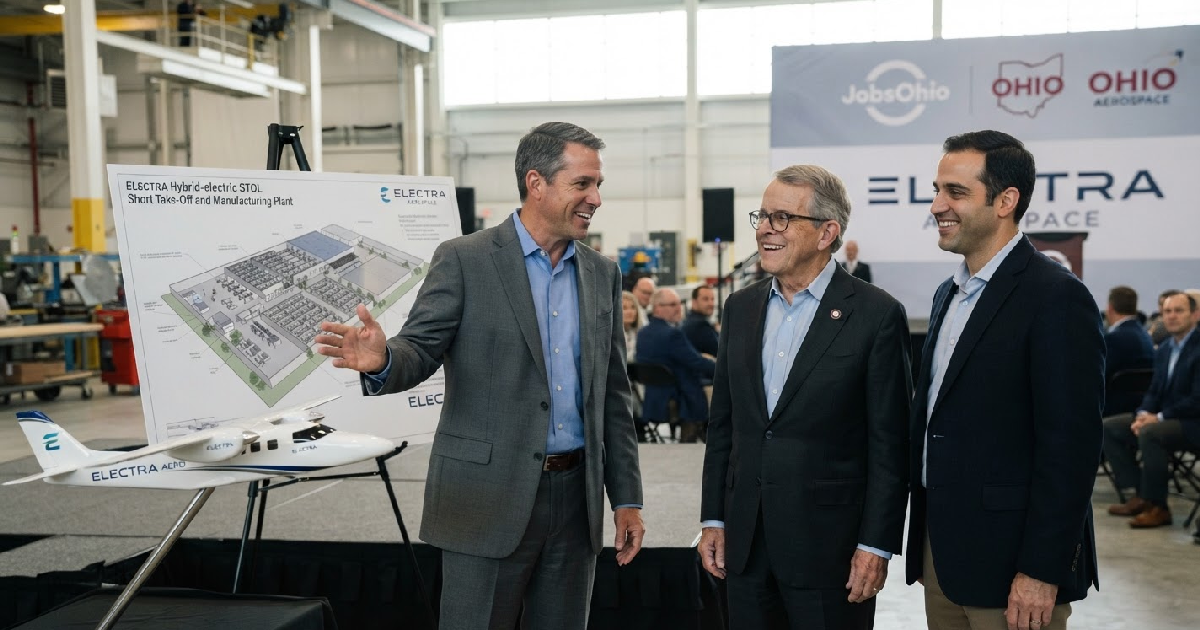
Electra, the Virginia-based hybrid-electric aircraft maker, will create nearly 2,000 manufacturing jobs with an $850 million investment in a new Ohio plant.
The company announced its first U.S. production facility for the nine-passenger EL9 Ultra Short plane on Tuesday, July 21, 2026, at the Farnborough International Airshow in England. Electra CEO Marc Allen shared the news alongside Ohio Governor Mike DeWine and JobsOhio President and CEO J.P. Nauseef, signalling a major boost for the advanced air mobility sector.
electra establishes first U.S. production facility
This new facility in Springfield, Ohio, marks a significant commitment by Electra to scale its operations. It’s set to become the company’s primary production plant, focusing exclusively on manufacturing the innovative EL9 Ultra Short model.
The substantial $850 million investment isn’t just for bricks and mortar; it underscores Electra’s long-term vision for mass production. It firmly positions Ohio as a central hub for advanced aviation manufacturing and a key player in the future of air travel.
the EL9 Ultra Short: a distinctive aircraft
The EL9 Ultra Short stands out for its unique operational capabilities, combining hybrid-electric propulsion with advanced aerodynamics. This fixed-wing aircraft is designed to perform in environments where traditional planes cannot.
Its core innovation lies in blown-lift technology, which directs propeller wash over the wings, dramatically increasing lift. This allows the EL9 Ultra Short to achieve take-off and landing distances of as little as 150 feet, opening up new possibilities for decentralised air travel.
The aircraft’s nine-passenger capacity makes it suitable for regional transport, cargo operations, and specialised missions. Its efficiency and ability to operate from minimal infrastructure could reshape how goods and people move in diverse terrains.
key figures at the farnborough airshow announcement
The Farnborough International Airshow provided a global stage for Electra’s pivotal announcement. CEO Marc Allen presented the details, emphasising the strategic importance of the Ohio location.
Ohio Governor Mike DeWine highlighted the economic benefits for the state, alongside J.P. Nauseef, President and CEO of JobsOhio. Their joint presence underlined a strong public-private partnership driving this industrial expansion.
Local leadership also played a vital role, with Mayor Rob Rue of Springfield and Rep. Mike Turner (R) 10th Congressional District attending. Their support shows the community’s commitment to fostering new technology and job growth.
underpinning advanced air mobility with capital
Electra’s ambitious manufacturing plans are built on a solid financial foundation. The company secured a crucial $115 million funding round in 2025, demonstrating significant investor confidence in its hybrid-electric vision.
Prysm Capital led this critical investment, with co-founder and managing partner Jay Park playing a key role in the fundraising effort. This capital infusion is essential for moving Electra from research and development into full-scale manufacturing operations.
For advanced air mobility startups, securing such substantial backing is often the biggest hurdle to commercialisation. This investment allows Electra to acquire the necessary machinery, develop its supply chain, and recruit a skilled workforce to produce hybrid-electric aircraft.
electra’s role in emerging aviation technology
Founded in 2020, Electra.aero, Inc. has quickly established itself as a frontrunner in advanced air mobility (AAM). The company’s core mission is to develop Ultra Short Takeoff and Landing (USTOL) aircraft.
This new production facility directly accelerates the commercialisation of AAM technology. It represents a tangible step beyond prototypes, moving the sector closer to widespread adoption and practical deployment.
The focus on hybrid-electric technology is critical for bridging the gap between current aviation capabilities and future sustainable solutions. It offers a practical path to decarbonisation while maintaining operational flexibility.
ohio’s growing aerospace hub
Ohio wasn’t chosen as Electra’s manufacturing site by chance. The state boasts a rich history in aviation and a well-established aerospace ecosystem, making it an attractive location for such an investment.
Springfield, in particular, offers strategic advantages, including a skilled labour pool and access to research and development infrastructure. This helps Electra tap into existing expertise in advanced manufacturing and engineering.
The presence of companies like Electra further solidifies Ohio’s reputation as an innovation hub for aerospace. It attracts more investment and talent, creating a virtuous cycle for the region’s industrial growth.
economic boost for springfield and the wider region
The $850 million Electra manufacturing plant promises a significant economic uplift for Springfield and the surrounding areas. The creation of 1,975 new jobs will have a ripple effect across the local economy.
These aren’t just factory floor positions; they include roles in engineering, logistics, and quality control. Such high-skill employment opportunities can attract new residents and bolster local businesses, from housing to retail.
JobsOhio’s involvement in the announcement highlights the state’s proactive approach to attracting high-tech industrial investment. Their support mechanisms likely played a critical role in Electra’s decision-making process.
shaping the future of regional transport
Electra’s EL9 Ultra Short is poised to redefine regional air travel. Its ability to operate from small, unimproved landing strips means it can connect communities currently underserved by traditional airports.
This capability makes it ideal for remote access, medical transport, and expedited cargo delivery in challenging environments. The technology promises to democratise air travel, extending its reach beyond major metropolitan areas.
The operational flexibility of USTOL aircraft could also alleviate congestion at larger airports. They offer a viable alternative for shorter routes, optimising air traffic flow and reducing ground travel times.
advances in propulsion and flight control
The hybrid-electric propulsion system in the EL9 combines traditional turbine engines with electric motors. This blend offers both power and efficiency, extending range while reducing fuel consumption and emissions.
Such integrated systems require sophisticated flight control and power management technology development. Electra’s success here could pave the way for broader adoption of hybrid solutions in other aviation segments.
The innovations developed for the EL9, particularly in its blown-lift and power systems, are transferable. They could influence future aircraft designs, pushing the boundaries of what’s possible in sustainable and accessible aviation.
broader impact on aerospace and U.S. industrial strategy
The establishment of this Electra plant marks a significant step for advanced air mobility. This sector aims to reshape how people and goods move, especially in areas with limited traditional infrastructure.
Aircraft like the EL9 Ultra Short are designed for operations beyond major airports. They can serve smaller communities and integrate effectively into existing transport networks.
Developing manufacturing capabilities for these advanced aircraft is critical. It supports national industrial strategies by keeping crucial aerospace technology development and job creation within the United States.
the practical role of hybrid-electric propulsion
Hybrid-electric propulsion systems offer a practical middle ground in aviation. They provide extended range and payload capacities compared to purely electric models.
These systems also deliver efficiency gains and reduced emissions. This makes them a viable solution for near-term adoption in commercial and cargo applications.
The experience gained from producing and operating the EL9 will be invaluable. It will inform future designs and manufacturing processes across the wider AAM industry.
Ultimately, Electra’s $850 million investment in Ohio underscores a growing trend in aerospace: the pursuit of more flexible, sustainable, and decentralised aviation solutions. It’s a tangible example of industrial capital meeting innovative technology to build the next generation of aircraft.
This development isn’t just about a single factory or a new plane; it’s about establishing the manufacturing infrastructure for an entirely new segment of the aviation industry. That’s a long-term play with broad implications for global supply chains and regional economies.
