


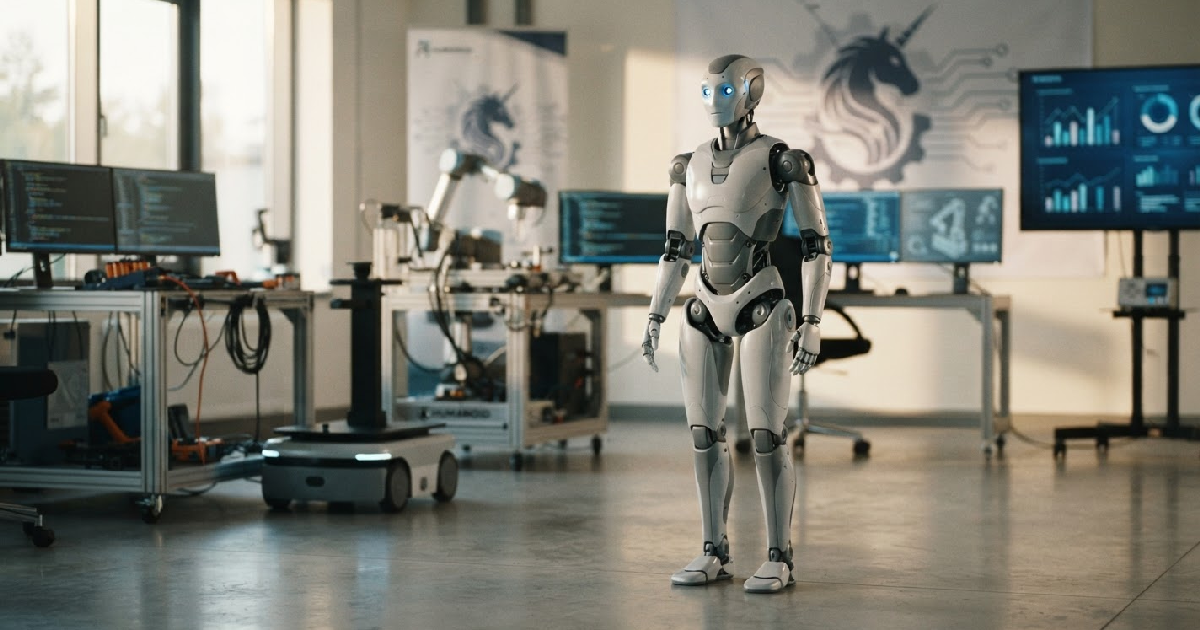
Humanoid has officially secured $152 million in Series A funding, achieving a post-money valuation of $1.35 billion (or €1.1 billion) and becoming an AI robotics unicorn.
This milestone makes Humanoid Europe’s first pure-play AI robotics unicorn. The funding round, announced on July 21, 2026, was led by the U.S. venture capital firm Prime Movers Lab, marking a pivotal moment for physical artificial intelligence development on the continent.
Europe’s first AI robotics unicorn emerges
Humanoid’s rapid ascent to unicorn status in just two years highlights strong investor confidence in its industrial automation approach. The $152 million Series A round stands as Europe’s largest for a company focused specifically on humanoid robotics, signaling a maturing market for advanced industrial AI solutions.
Prime Movers Lab, founded in 2018 by Dakin Sloss, focuses on funding “breakthrough scientific startups” that address pressing global challenges. Their investment in Humanoid aligns with a strategy to back companies making deep technology innovations across sectors like manufacturing and infrastructure.
Other notable participants alongside Prime Movers Lab included Schaeffler, Bosch, Fubon Financial Holding Venture Capital, and Aglaé Ventures, the investment vehicle backed by LVMH’s Arnault family. This diverse investor base signals both significant financial interest and strategic alignment from major industrial players and global luxury brands looking at future automation capabilities.
Wheeled robots for industrial floors
Humanoid’s product strategy centres on purpose-built, wheel-driven robots like the HMND 01, designed specifically for complex factory environments. These machines prioritise stability, speed, and the ability to handle heavy payloads on industrial floors, distinguishing them from traditional bipedal designs.
The HMND 01, described as a bimanual mobile manipulator, leverages its wheeled mobility to cover an estimated 85-90% of typical industrial use cases more efficiently. This approach offers enhanced energy efficiency and a lower centre of gravity, crucial for safety and performance in busy production settings.
This design choice also positions Humanoid for quicker CE certification under existing autonomous mobile robot (AMR) and collaborative-robot (cobot) industrial frameworks. The company targets full certification by late 2027, accelerating market entry. While a bipedal version (HMND 01 Alpha Bipedal) exists, Humanoid is re-targeting it for service and household applications as a mid- to long-term strategy.
KinetIQ powers intelligent robot operations
The core of Humanoid’s technical ecosystem is KinetIQ, its proprietary physical artificial intelligence framework. KinetIQ functions as the central intelligence, processing vast amounts of sensor data in real-time for precise spatial reasoning across entire robot fleets.
This four-layer AI stack is built on NVIDIA compute, providing the robust processing power needed for complex decision-making. KinetIQ Ascend, an advanced extension of the platform, enhances learning capabilities, allowing robots to learn from trial and error in real-world industrial scenarios.
The system enables Humanoid’s machines to navigate busy work floors, interact with materials, and perform intricate assembly tasks safely alongside human operators. By tightly integrating proprietary hardware with native AI software, the company directly addresses persistent labour shortages across global manufacturing, logistics, and retail distribution centres.
Significant commercial traction and partnerships
Humanoid’s impressive valuation isn’t solely based on its technological prowess; it also reflects substantial commercial traction and high-profile industry alliances. The company has forged strategic software and hardware partnerships with global technology leaders including NVIDIA, SAP, Siemens, and Bosch, integrating their systems for broader industrial application.
A standout achievement is the multi-year agreement signed with motion technology giant Schaeffler, which will see Schaeffler deploy 1,000 of Humanoid’s wheeled robots across its global manufacturing plants. This represents the industrial robotics sector’s largest publicly announced commercial deal, underscoring the trust placed in Humanoid’s technology.
This large-scale deployment signals that general-purpose industrial robotics is moving rapidly from laboratory research to active production lines. Beyond deployment, Bosch will also act as Humanoid’s contract manufacturing partner, securing production capacity for 100,000 units over the next five years and providing critical technical expertise in hardware design, production, and supply chain management.
These early commitments demonstrate significant market demand for Humanoid’s solutions. The firm has already secured 34,000 robot pre-orders, collectively valued at an estimated $2.4 billion, indicating a strong pipeline and widespread industry interest.
Scaling production and global reach
The new capital infusion will be instrumental in allowing Humanoid to scale its operational infrastructure and expand its research facilities, accelerating manufacturing capabilities. The company currently employs more than 250 engineers and roboticists across its offices in London, Boston, Vancouver, and San Diego, reflecting a truly international operational footprint.
Humanoid plans to initiate the commercial rollout of Beta-version robots to select enterprise customers in logistics, manufacturing, and retail during Q4 2026. This phased deployment will precede full-scale mass production of its wheeled robots, ensuring real-world validation before wider availability.
To support this expansion, Humanoid will occupy 42,000 sq ft of new lab space at One Triton Square, Regent’s Place, London. Achieving mass manufacturing at this early stage is a strategic move to establish strong market dominance in industrial automation and position the company for leadership in the evolving robotics landscape.
The startup will also look to enter the broader general-purpose robotics market. The investment in Humanoid’s technology proves Europe’s ability to build commercially viable robotics companies, competing with established AI and robotics hubs in the United States and China. This global competition often relies on efficient logistics and transport networks for critical components, to sustain rapid industrial development.
Artem Sokolov’s vision for augmenting human potential
Artem Sokolov, Humanoid’s founder and Chief Executive Officer, founded the company in May 2024 with a clear vision. His inspiration stemmed from observing the repetitive and often monotonous work of his grandparents in jewellery manufacturing, sparking a desire to create robots that free humans from such physically demanding tasks.
Before establishing Humanoid, Sokolov spent over a decade growing his family’s manufacturing business into a billion-dollar enterprise, providing him with firsthand insight into the practical challenges of production facilities. Recognized with the EY Entrepreneur of the Year award in 2021, he also holds an Executive Certificate in AI and Digital Business Excellence from IMD, combining entrepreneurial acumen with technical understanding.
Sokolov maintains that transforming advanced physical AI into practical, everyday industrial tools demands exceptional execution speed from dedicated engineering teams. “What we’ve accomplished in such a short time would typically take a decade,” Sokolov noted, crediting an “extraordinary team” for challenging conventional possibilities.
His philosophy centres on using robotics to elevate human potential by taking over dangerous, tedious, or ergonomically punishing tasks, rather than simply replacing human workers. As Zia Huque, General Partner at Prime Movers Lab, stated, “Humanoid robotics will be one of the defining technologies of the next decade, reshaping how commercial and industrial work gets done.”
This investment, Sokolov believes, provides the necessary resources to accelerate their mission and redefine global industrial productivity for decades to come, with robots working safely and collaboratively alongside people in diverse environments.
