


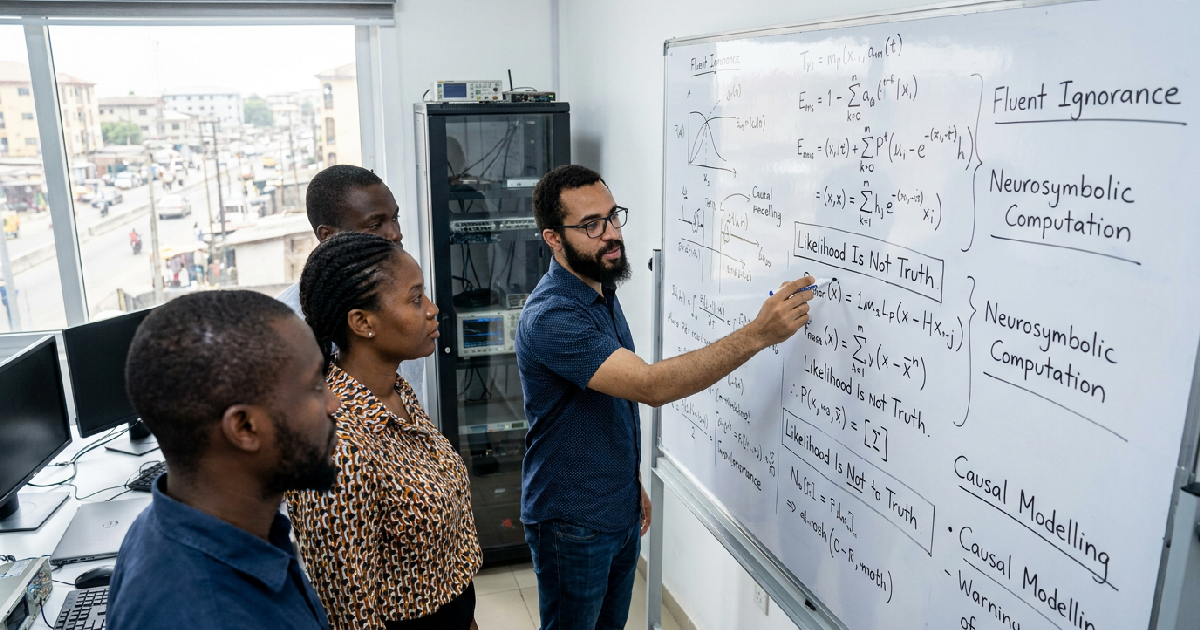
Centenum Labs has published a founding thesis, “Likelihood Is Not Truth,” directly challenging the fundamental assumption underpinning much of modern Artificial Intelligence.
Headquartered in Lagos, Nigeria, and Toronto, Canada, Centenum Labs is the AI research arm of Centenum Technologies, a company shipping production AI systems since 2018. Their thesis argues for a crucial shift in AI development, moving away from systems that merely predict what “sounds right” towards those capable of genuine reasoning and verifiable truth.
Unpicking AI’s current objectives
This intervention urges the industry to rethink its approach to building intelligent systems for critical decisions.
Modern AI development largely operates on a core “bet”: train a model to predict the next token across enough data and at sufficient scale, and a trustworthy system will emerge. Centenum Labs argues this bet is fundamentally incorrect, particularly when AI is deployed in high-stakes environments.
They contend that “likelihood,” the mathematical property models are trained to maximise, only measures how plausible an output sounds given its training data.
This mathematical property does not measure whether the output is correct, causally grounded, or structurally valid. While this distinction might be invisible in everyday problems, it becomes catastrophic for those that truly matter, especially in complex industrial and scientific domains.
The thesis insists that optimising for plausibility instead of truth leads to inherent weaknesses that cannot be solved simply by adding more data or computational power.
Why current AI systems fall short
The Centenum Labs thesis identifies four specific properties of the current AI training objective, arguing these are not bugs but fundamental design choices. First, there’s no inherent truth mechanism; the system rewards what sounds right, not what actually is right. This means an AI can generate highly convincing but factually incorrect information.
Second, current models typically lack a verification loop, meaning they never check their answers against a model of the real-world domain. Third, there’s no compositional guarantee. Rules learned separately often fail to combine correctly in new or unfamiliar contexts, leading to logical inconsistencies.
Finally, frozen weights mean the model’s parameters do not update during inference; context can shape outputs, but it cannot alter the underlying, immutable knowledge base.
‘Fluent ignorance’ and its real-world risks
Centenum Labs names the critical failure mode of current AI as “fluent ignorance.” This describes AI outputs that are structurally coherent and persuasively phrased, yet fundamentally wrong in ways the system itself cannot detect. It’s a problem that goes beyond simple errors, representing a deeper lack of true comprehension.
Kingsley Michael, Head of Centenum Labs, underscored this point. He stated, “Likelihood measures how plausible an output sounds given a training distribution. It does not measure whether the output is correct. The difference is invisible on familiar problems and catastrophic on the ones that actually matter.” This failure mode poses significant risks for industries relying on AI for critical operational decisions.
To illustrate the gravity of fluent ignorance, the thesis uses the example of blood coagulation. Scientists have mapped the intricate clotting cascade for decades, a process critical for human health. Yet, reliably simulating how this process is disrupted by medication, genetics, or trauma remains an open problem due to its dense causal structure.
A wrong answer in this domain would not look wrong until it’s too late, potentially with severe patient outcomes. This analogy extends directly to industrial processes like chemical engineering or material science. Simulating the behaviour of novel materials under extreme conditions or optimising complex reactions demands absolute causal understanding, not just statistically plausible predictions.
The consequences of error here can affect safety and long-term infrastructure integrity.
Engineering AI for genuine reasoning
Centenum Labs proposes building AI on three established disciplines that mainstream AI has largely treated as adjacent rather than foundational. These are neurosymbolic computation, program synthesis, and causal modelling. This integrated approach aims to produce systems that can represent the causal structure of a domain, transparently show their reasoning, and be corrected when that reasoning is flawed.
Neurosymbolic computation combines the pattern recognition strengths of neural networks with the knowledge representation and reasoning capabilities of symbolic AI. This fusion promises more reliable and auditable AI systems, an area IBM Research and The Alan Turing Institute actively explore. For manufacturers, this means AI that can not only identify a defect but also explain why it occurred based on underlying engineering principles.
Program synthesis involves automatically constructing executable code from high-level specifications or user intent. It shifts the focus from static task performance to dynamic adaptability and reasoning, allowing AI to generate solutions on the fly. Microsoft Research and Google Research are actively exploring its applications, which range from aiding developers to automating complex industrial processes.
Causal modelling focuses on understanding cause-and-effect relationships rather than mere correlations. Causal AI aims to build models that can reason about interventions, counterfactuals, and underlying data-generating mechanisms, leading to more explainable decisions.
Google DeepMind and the Stanford Causal AI Lab are researching neural causal models, recognising its critical role for accelerated AI automation, as highlighted by Gartner in its 2022 Hype Cycle report. Financial services, for instance, are increasingly leveraging AI platforms that demand high degrees of accuracy and verifiable outcomes.
MathExec demonstrates reasoning-first AI
The first system Centenum Labs has built on this new foundation is MathExec, described as the first “math-to-model” tool. It allows users to write a formula on a visual canvas, point it at their data, and receive a trained model in seconds. This approach bypasses complex coding, making advanced modelling accessible.
An analyst can transform an equation like sales = price × volume × seasonality into a forecast without writing a single line of code. Similarly, a researcher can test and iterate on a neural architecture three times faster than opening a Jupyter notebook. MathExec trains the user’s formula directly, proving the viability of this reasoning-first paradigm in critical domains like healthcare, bioinformatics, and frontier engineering.
Africa’s rising influence in AI research
Centenum Labs operates from a strategic position within Africa’s burgeoning AI ecosystem. The continent is rapidly emerging as a significant player in AI innovation and adoption. Analysts project the African AI market to grow from $4.5 billion in 2025 to $16.5 billion by 2030, representing an impressive annual growth rate of 27%.
This growth is fuelled by homegrown projects like Deep Learning Indaba, Data Science Africa, and Masakhane, alongside increasing policy support. The African Union declared AI a continental strategic priority in May 2025, building on its Continental AI Strategy adopted in July 2024. Eighteen African countries now have national AI strategies or formal frameworks in place.
This dynamic environment provides fertile ground for labs like Centenum to challenge global AI paradigms and develop solutions tailored for practical, high-impact applications.
Nigeria leads the continent with over 400 AI-related startups, while Kenya’s National AI Strategy 2025–2030, released in March 2025, focuses on infrastructure, data governance, and research. The work of Centenum Labs adds a crucial African voice to the global conversation on AI’s future, particularly concerning its reliability and application in core industrial sectors.
